
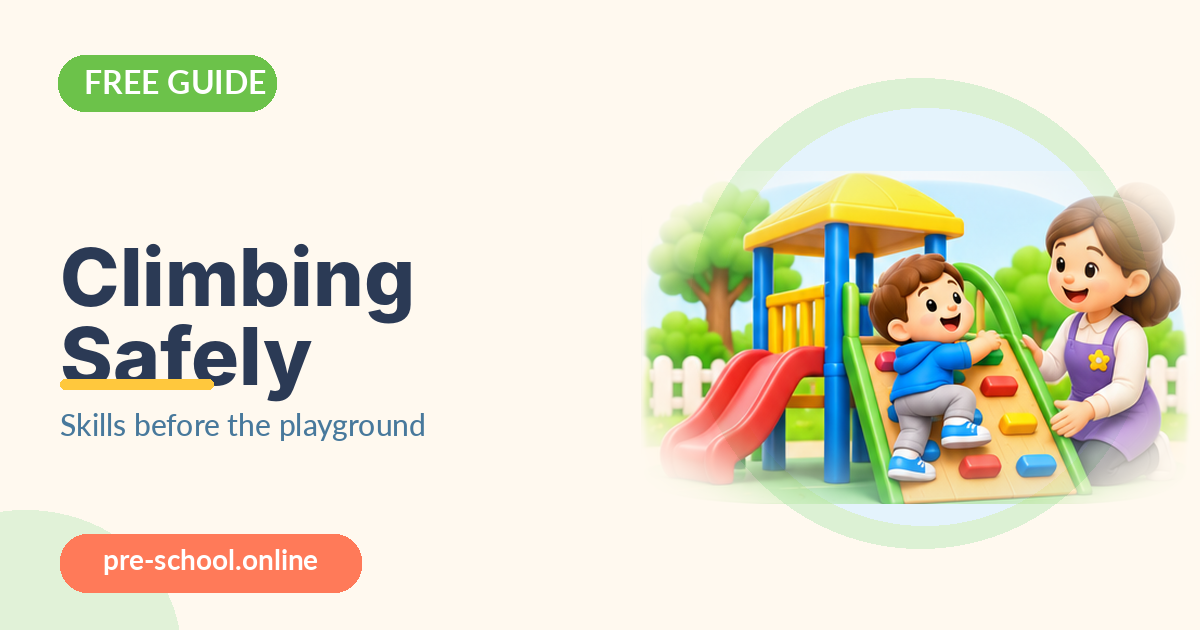
Practical preschool guidance · Ages 3–5 · Toy and Play Safety · PSB-0182
Climbing appeals to preschoolers because it turns a small challenge into a visible achievement: one rung, then another. Before a child uses climbing equipment, however, they need more than the instruction to be careful. They need a few concrete rules, an adult close enough to supervise and equipment designed for their age and abilities.
This guide explains what to teach before the first climb, how to practice a safe descent, and what caregivers should inspect before allowing play. It supplements—rather than replaces—the equipment manufacturer's instructions and playground maintenance checks.
- For parents and teachers
- Hands-on activities
- No expensive supplies
Key Takeaways
- Choose equipment intended for the child’s age and ability; inspect the structure and the protective surfacing.
- Teach one climber at a time, hands on secure grips and feet on stable footholds.
- Practice coming down before climbing higher; do not require children to jump off.
- Remove bike helmets, drawstring clothing and dangling accessories before using playground equipment.
In This Article
Understand the Goal
Climbing involves balance, strength, planning, grip control and a sense of one's own limits. The goal is not to reach the top as quickly as possible. For a new climber, confidently stepping up one safe rung and back down with adult support can be a full success.
Adults should distinguish supervised skill-building from unsafe challenges. A young child may be eager but unable to reliably judge heights, crowding or whether a handhold is secure. An attentive caregiver needs to anticipate hazards and set boundaries instead of relying on the child to manage every risk.
Important distinction: The aim is a useful experience, not a test score or a race to finish. Follow the child’s questions, pace, strengths and individual support needs.
What Makes This Work
Check the posted age range, the manufacturer's instructions, the condition of platforms and rails, and the impact-absorbing surface below. The CPSC playground handbook distinguishes age-appropriate equipment and emphasizes protective surfacing and supervision. Avoid equipment with broken pieces, exposed bolts, dangerously hot surfaces, loose ropes, entrapment gaps or unsuitable heights.
Bike and scooter helmets belong on riders, but should be removed before climbing or using playground structures because they can become an entrapment hazard. Clothing with neck or waist drawstrings, scarves, jewelry and dangling straps should be removed or secured. Do not bring ropes or skipping cords onto the equipment.
Before beginning, choose a time when the child is reasonably rested, check that the materials and play space are age-appropriate, and demonstrate the first turn yourself. A child can take part by observing, pointing, moving an object, speaking, drawing or directing an adult; do not make verbal performance the price of participating.
Eight Practical Activities and Strategies
Start with one idea rather than attempting all eight in a single session. Revisit activities that capture the child’s interest, and keep the adult’s instructions shorter than the child’s play.
1. Read the playground before the child climbs
Pause at the entrance and check age signs, the surfacing, wet areas, damaged attachments, hot slides and crowding. A child may observe you checking a handrail without being made responsible for safety. If the only available structure is intended for older children, choose ground-level movement activities instead. Leave and report hazards to the operator rather than attempting a repair while children play.
2. Teach the difference between a handhold and a decoration
On low equipment, point to a stable rung and say 'This is where your hand can hold.' Avoid assuming a painted panel or decorative bar is meant to carry weight. Show the child how to pause and look for their next secure grip. Stay close enough to respond immediately if they lose balance; do not stand below and encourage an uncontrolled leap.
3. Practice stepping down first
Before climbing upward, demonstrate a short step down from a very low height with an adult right beside the child. Ask them to look toward their feet and use the steps or ladder rather than jumping. Some children prefer to turn around and descend facing the ladder; follow the equipment design and safe instructions. Stop if the child cannot descend comfortably.
4. Use one-at-a-time rules on narrow structures
When a ladder or bridge is narrow, teach 'Wait until the space is clear, then go.' Model waiting beside the equipment, not on the ladder. If the playground is crowded, move to a different activity. A five-year-old may understand a simple turn cue; a three-year-old often needs an adult to keep physical spacing safe.
5. Keep the body in the correct direction
Explain the particular structure's safe use: feet first on slides, hands on rails when appropriate and no climbing up slide chutes when others are descending. Use one instruction at a time. If a child starts a risky shortcut, calmly block the route and show the correct way, rather than shouting complex directions across the playground.
6. Agree on a reliable stop signal
Before play, choose one simple cue: 'Stop and look at me.' Practice it on the ground with a gentle game. During climbing, use the cue only for a real pause or safety issue, then give the next clear action. A signal is an aid to adult supervision, not permission to step away or let the child wander to other structures.
7. Know when to choose a smaller challenge
If the child freezes, shakes, cries or cannot find a stable foothold, guide them safely back down and offer an easier route. Avoid lifting them to a height they cannot reach or descend independently. Celebrate careful decisions: 'You noticed that rung felt too high, so you chose another path.' Confidence develops through manageable successes.
8. End with an equipment and clothing reset
After play, check that shoes are secure and remove any hazards the group brought into the area. Reinforce one observed safety behavior: 'You waited until the ladder was clear.' Drink water and rest if needed. Before the next climbing session, inspect the equipment again; a playground that was fine yesterday can be damaged or crowded today.
Try a related free resource: Explore activities for this skill. The resource is a follow-up to the practical steps above, not a replacement for them.
An Everyday Example
At the park, a four-year-old runs toward a tall climbing wall. Her caregiver sees that the sign labels it for older children and redirects her to a lower structure with suitable surfacing. They practice holding one rung and coming down. The child asks to go higher, so the caregiver offers another safe step and stays within reach. The success is a controlled climb and descent—not getting to the top of the highest wall.
Notice how the adult makes the goal easier to reach: instead of requiring instant mastery, they make the next action clear, respond to the child’s idea and change the environment when needed. This same method works at home, with a small group or in a preschool learning center.
A Flexible Five-Day Practice Plan
This is an optional rotation, not a deadline. Repeat a successful invitation or skip a day when attention, energy or circumstances call for it.
| Day | Simple invitation | What to notice |
|---|---|---|
| Day 1 | Walk the play area and identify the preschool-height section | Whether the child approaches with curiosity |
| Day 2 | Practice a one-step climb and controlled descent | How the child responds to the model |
| Day 3 | Rehearse waiting until a ladder is clear | What words, actions or choices emerge |
| Day 4 | Repeat with a short pause/stop cue | Whether the child tries a new variation |
| Day 5 | Let the child choose one comfortable safe challenge | Which activity they want to revisit |
Keep a learning note, if useful: Record a concrete observation such as “stepped down one rung before climbing higher” rather than judging the child as ahead or behind. Use notes to choose another enjoyable invitation, not to create a new scoring system.
Adjust for Different Learners
For children who are hesitant, begin with ground-level stepping stones or balance play and let them watch others without pressure. Children with motor, balance or mobility differences may need individualized equipment and professional or school guidance. Age labels are a starting point, not a guarantee that a particular child can safely use a structure.
Teachers should plan line-of-sight coverage and ensure that one adult does not have to monitor several blind spots at once. Children should not be asked to supervise one another as substitutes for adults.
Children develop skills unevenly, and successful participation may look different from one child to another. If a concern persists across settings or affects everyday functioning, discuss your observations with the child’s caregivers, teacher or pediatric professional rather than trying to diagnose the child from an activity.
If Something Does Not Work
If a child rushes ahead, use a nearby ground-level pause place and rehearse 'wait, look, climb' when calm. If they refuse to descend, remain close, guide them using appropriate steps and seek on-site help if necessary; do not pull from an unstable position. If surfaces are wet, hot or damaged, end climbing for that day. If another child is crowding the ladder, move away rather than relying on verbal warnings alone.
Try changing only one feature at a time: simplify the materials, shorten the instruction, move to a quieter place, or let the child watch first. You will learn more from a calm retry than from insisting on the planned activity.
Frequently Asked Questions
Should preschoolers wear bike helmets on playground climbers?
No. Remove helmets before climbing structures; helmets may catch in playground openings. Helmets are for appropriate wheeled riding activities.
Can a child climb on equipment meant for older children if they are tall?
Choose structures appropriate to the posted age group and the child’s ability; height alone is not a sufficient safety test.
Is it safer to hold a child while going down a slide?
Adults should avoid sliding with a child on their lap because the child’s leg may be caught or injured.
What if the protective surface looks worn?
Avoid questionable equipment and report the concern to the playground operator; adequate impact-absorbing surfacing matters.
Free Preschool Resources to Try Next
For a practical next step, start with the relevant resource below. These are existing Pre-School.online pages; the ideas in this guide can also be completed using everyday materials without visiting another page.
Sources and Further Reading
- Pre-School.online: Related Learning Resource
- CPSC: Public Playground Safety Handbook
- CPSC: Public Playground Safety Checklist
This article offers general education guidance, not individualized developmental or medical advice. Supervise age-appropriate activities, follow manufacturers’ instructions and your school’s policies, and use qualified professional guidance for specific safety or developmental concerns.