
Practical preschool guidance · Ages 3–5 · Early Learning Skills · PSB-0177
Words such as above, below, beside and between help children understand instructions, describe a picture and organize objects in space. They can be difficult to learn from a definition alone because their meaning changes with the position of the objects.
Movement and hands-on play make the words visible. Instead of asking a preschooler to memorize a vocabulary list, use a stuffed animal, a cardboard box and a few household objects to show the relationships again and again in different contexts.
- For parents and teachers
- Hands-on activities
- No expensive supplies
Key Takeaways
- Teach one or two position words at a time using real objects and movement.
- Always name the reference object: 'The bear is beside the box.'
- Give the child a chance to place objects and then describe what changed.
- Practice with pictures, stories and active games after a clear hands-on example.
In This Article
Understand the Goal
Spatial language describes relationships between people and things. 'Above' only makes sense when there is something underneath it, and 'beside' identifies closeness at the side. These words are useful in daily instructions such as 'Put your shoes below the shelf' and in early geometry, storytelling and reading comprehension.
Preschoolers may confuse words if adults switch the reference point without saying so. When you say 'The cup is beside the plate,' make sure both are visible and show which object you mean. Children should first experience the relationship, then hear the label, then use it themselves.
Important distinction: The aim is a useful experience, not a test score or a race to finish. Follow the child’s questions, pace, strengths and individual support needs.
What Makes This Work
Introduce opposites when they make sense, but do not overload a lesson with above, below, between, around, through and behind at once. Show the word from the child’s perspective. An object that is 'left of' another may appear differently to someone facing the other way, so start with less viewpoint-dependent relationships. Use safe, large objects and clear floor spaces; avoid games that involve climbing onto unsafe furniture.
Before beginning, choose a time when the child is reasonably rested, check that the materials and play space are age-appropriate, and demonstrate the first turn yourself. A child can take part by observing, pointing, moving an object, speaking, drawing or directing an adult; do not make verbal performance the price of participating.
Eight Practical Activities and Strategies
Start with one idea rather than attempting all eight in a single session. Revisit activities that capture the child’s interest, and keep the adult’s instructions shorter than the child’s play.
1. Move a teddy bear above and below
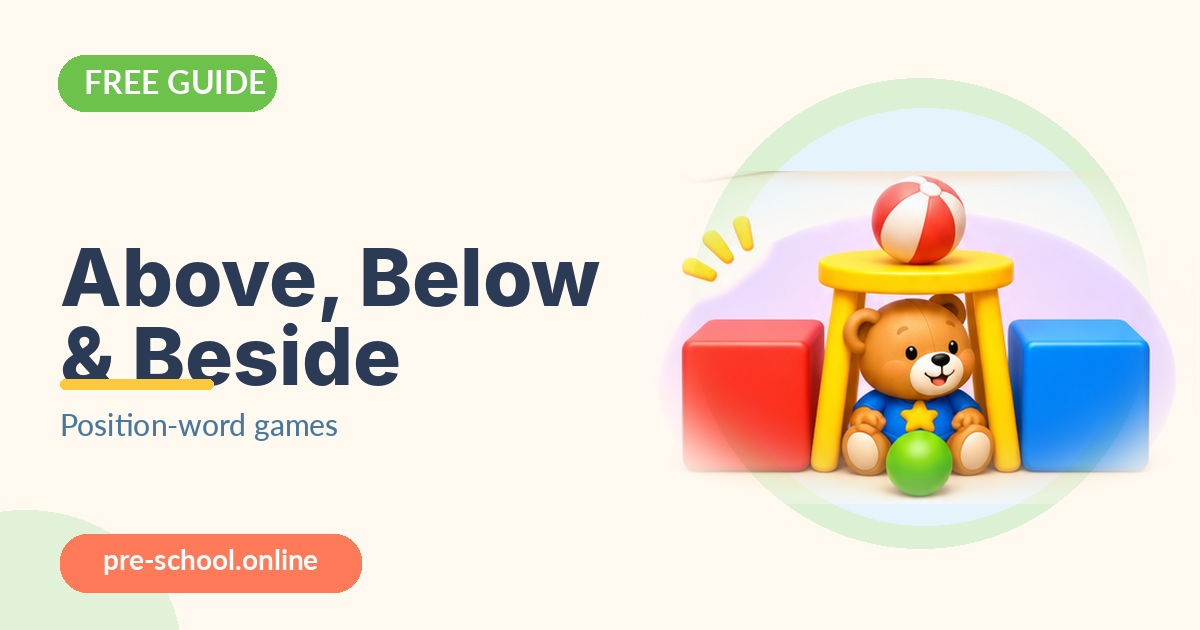
Hold a bear above a sturdy low box and say, 'The bear is above the box.' Put it below an open table that is safe and reachable and repeat with 'below.' Invite the child to direct your hands. Switch roles so they act and you describe. Keep the two objects visible as the reference relationship changes.
2. Make a beside-the-box photo
Place a favorite toy beside a shoebox, take a quick photo or sketch the arrangement, then move the toy behind it. Compare the pictures. Ask, 'Where is the toy now?' If the child points, translate the gesture into language: 'Yes, beside the box.' Avoid demanding a spoken response before the child understands the concept.
3. Build a between bridge
Set two large blocks a short distance apart and place a small soft animal between them. Say, 'The rabbit is between the blocks.' Move the animal beside one block and ask what changed. For older children, add a third landmark to see whether they can explain 'between' clearly without guessing.
4. Give a short treasure direction
Hide a large, familiar toy in plain sight and offer one clue: 'Look below the chair.' After success, let the child hide the toy and direct you. Use just one position word per clue at first. Move into two-step directions only when they are comfortable and the game remains fun.
5. Move your body around a floor shape
Place a large paper circle on the floor. Ask the child to stand beside it, step across it or put a foot above it without jumping onto furniture. Use movement options that suit the child, including pointing or moving a toy figure. The goal is to experience spatial vocabulary, not demonstrate athletic ability.
6. Arrange a pretend picnic
Set out a cloth, plate and cup. Ask where the cup should go: beside the plate or between two napkins? Let the child change the arrangement and explain their choice. This is a real-world application of the same words and can turn into a language-rich pretend café game.
7. Read a picture for position clues
Open a detailed picture book and describe one clear relationship: 'The bird is above the tree.' Invite the child to find something beside the house. If the illustration is crowded, point to two objects first to reduce ambiguity. Gradually invite the child to describe an arrangement without your model.
8. Play position-word director
Give the child the role of director and a set of large blocks. You follow their instructions exactly: 'Put the blue block beside the red one.' If the phrase is unclear, ask a genuine clarification question. This develops precise language and gives children the satisfaction of controlling the game.
Try a related free resource: Explore activities for this skill. The resource is a follow-up to the practical steps above, not a replacement for them.
An Everyday Example
During a quiet afternoon, a parent puts a toy dog beside a cushion. The child says the dog is 'at it.' The parent repeats, 'Yes, the dog is beside the cushion,' then moves the dog between two cushions. The child directs the next move and eventually says 'below the table' without being quizzed. Spatial language emerges from meaningful choices and repeated examples.
Notice how the adult makes the goal easier to reach: instead of requiring instant mastery, they make the next action clear, respond to the child’s idea and change the environment when needed. This same method works at home, with a small group or in a preschool learning center.
A Flexible Five-Day Practice Plan
This is an optional rotation, not a deadline. Repeat a successful invitation or skip a day when attention, energy or circumstances call for it.
| Day | Simple invitation | What to notice |
|---|---|---|
| Day 1 | Teach above and below with a toy and box | Whether the child approaches with curiosity |
| Day 2 | Introduce beside using two visible objects | How the child responds to the model |
| Day 3 | Build a between scene using two blocks | What words, actions or choices emerge |
| Day 4 | Play a one-clue treasure hunt | Whether the child tries a new variation |
| Day 5 | Let the child direct your object placement | Which activity they want to revisit |
Keep a learning note, if useful: Record a concrete observation such as “used beside while moving a teddy bear” rather than judging the child as ahead or behind. Use notes to choose another enjoyable invitation, not to create a new scoring system.
Adjust for Different Learners
Children learning new words may need two contrasting demonstrations before using them. For children learning English, use the home language alongside English when possible. Nonverbal children can demonstrate the position by moving objects. Older preschoolers can combine two ideas: 'Put the toy between the cups and below the shelf.' For children with mobility needs, tabletop scenes and toy figures work as well as whole-body games.
Children develop skills unevenly, and successful participation may look different from one child to another. If a concern persists across settings or affects everyday functioning, discuss your observations with the child’s caregivers, teacher or pediatric professional rather than trying to diagnose the child from an activity.
If Something Does Not Work
If a child confuses above and below, demonstrate both at the same time with the same two objects, then swap slowly. If 'between' remains unclear, place the figure directly in the gap between two large blocks instead of using an abstract picture. If children guess at directions, simplify to one relationship and repeat it across contexts. Avoid correcting every spontaneous phrase; model the precise word naturally.
Try changing only one feature at a time: simplify the materials, shorten the instruction, move to a quieter place, or let the child watch first. You will learn more from a calm retry than from insisting on the planned activity.
Frequently Asked Questions
Which position words should I teach first?
Start with relationships you use naturally, such as above, below and beside, and add between when the child can see two reference objects.
Should preschoolers write position words?
No. Listening, acting and describing locations are useful starting points before writing.
What if my child uses the wrong word?
Show the relationship clearly, model the word and invite another playful turn.
Can position words support math?
Yes. They describe spatial relationships that also appear in shape, construction and early geometry play.
Free Preschool Resources to Try Next
For a practical next step, start with the relevant resource below. These are existing Pre-School.online pages; the ideas in this guide can also be completed using everyday materials without visiting another page.
Sources and Further Reading
This article offers general education guidance, not individualized developmental or medical advice. Supervise age-appropriate activities, follow manufacturers’ instructions and your school’s policies, and use qualified professional guidance for specific safety or developmental concerns.