
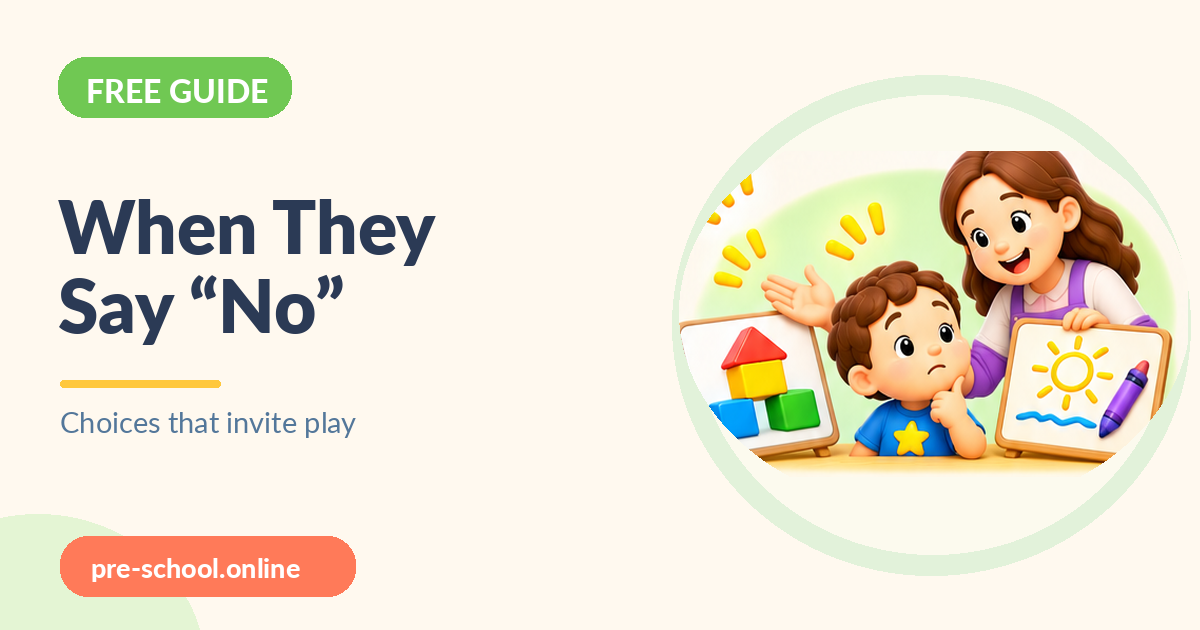
Free practical guide · Ages 3–5 · Feelings and Behavior · PSB-0250
You lay out a lovely preschool activity, and your child says “No.” You offer drawing, puzzles and a book; the answer stays no. Repeated refusal can feel personal, but it may communicate a need for rest, autonomy, connection, predictability or an easier entry point. The most useful response is to become curious about the situation rather than trying to win the interaction.
Preschoolers do not experience every proposed activity as an invitation. A complicated setup can feel like work; a transition away from a favorite game can feel abrupt; too many choices can be overwhelming. Refusal is information, not a diagnosis. Adults can set necessary safety boundaries while offering meaningful control over optional learning activities.
- For families and preschool educators
- Hands-on and age-appropriate
- Adaptable for real classrooms
Key Takeaways
- You lay out a lovely preschool activity, and your child says “No.
- Before suggesting a new task, notice hunger, tiredness, illness, sensory overload, time of day and whether the child has already had enough adult-directed activity.
- A child’s “no” can be a meaningful boundary or request for a break.
Why This Approach Matters
Preschoolers do not experience every proposed activity as an invitation. A complicated setup can feel like work; a transition away from a favorite game can feel abrupt; too many choices can be overwhelming. Refusal is information, not a diagnosis. Adults can set necessary safety boundaries while offering meaningful control over optional learning activities.
Starting point: A useful preschool activity should make room for the child to look, move, talk, point, draw or participate in another accessible way. Adults can model once and then adjust the activity instead of increasing pressure.
Before You Begin
Before suggesting a new task, notice hunger, tiredness, illness, sensory overload, time of day and whether the child has already had enough adult-directed activity. Choose two simple options that you can genuinely honor. Avoid offering a choice that is not real—“Do you want to put on your seat belt?” is not optional; you can instead offer “Do you want to climb in yourself or have help?” Safety is not negotiated.
Eight Practical Activities and Strategies
1. Connect before suggesting an activity
Sit nearby and observe what the child is already doing. Comment without correcting: “You have made a long train.” After a moment, ask whether you may join. A child who feels interrupted may reject even an appealing activity. Joining the current play creates an opportunity to introduce language and thinking from within the child’s own interest.
2. Offer two choices, not a menu of ten
Try “Would you rather draw a road or build one with blocks?” The options should both be acceptable, available and developmentally suitable. If the child says “Neither,” pause and ask whether they need a break. A small genuine choice gives autonomy without the cognitive load of scanning a whole shelf of possibilities.
3. Make the first step tiny
Instead of “Let us do a fifteen-minute numbers lesson,” offer “Can you park one car by the blue block?” Then stop and see whether the child wants more. Success is entering the activity, not completing an adult plan. If the child moves away, notice that information and try later rather than escalating the demand.
4. Give a preview before transitions
Say, “After we put the big blocks back, you can choose a story or a snack.” Use pictures or a short countdown if helpful, and allow time for the child to finish one small part of the current game. Sudden interruptions often produce resistance that has little to do with disliking the next activity.
Free related resource: For additional ways to practice, explore Pre-School.online’s relevant feelings and behavior resource. The steps in this article can be used on their own.
5. Try parallel play instead of direct invitations
Begin building your own small structure beside the child without asking them to copy. Narrate a problem you encounter: “My bridge keeps falling.” The child may watch, offer a solution or join when ready. This can be especially helpful for children who dislike adult attention on their performance. Parallel play is not a trick to force participation.
6. Use interests as the vehicle for learning
If the child loves animals, count pretend pets rather than paper circles. If they love cars, talk about long and short roads rather than tracing lines on demand. The aim is not to hide worksheets inside play; it is to recognize that counting, language and problem solving can develop through the child’s genuine interests.
7. Separate emotions from required boundaries
When a child refuses a required routine, name the feeling while maintaining the boundary: “You do not want to leave. We still need to go. Would you like to carry the bag or hold my hand?” For optional art or reading time, the answer may genuinely be no. Distinguishing the two prevents adults from treating all refusal as disobedience.
8. Notice patterns and seek collaboration when needed
Write down what happened just before a refusal: a noisy group, difficult task, hunger, transition or repeated questions. Ask the child’s educator what works in another setting. If refusal is sudden, severe, persistent or accompanied by distress, illness signs, communication concerns or developmental changes, talk with an appropriate healthcare professional. Do not diagnose from a single blog checklist.
At Home and in the Classroom
At home
Try one short invitation after basic needs have been met. Follow the child’s current interest, offer two choices and give permission to take a break. Keep a few flexible materials accessible rather than setting out an elaborate activity that has to be completed.
In preschool or a group
Use predictable transitions, visual choices and accessible entry points. Provide a quiet option and let a child participate by watching before joining. Review whether the activity is too long, too noisy or too language-heavy, and collaborate with caregivers around recurring patterns.
In either setting, watch for engagement and comfort. If an activity creates pressure or becomes too complex, offer a smaller entry point and revisit it another day. Learning through play can be both purposeful and responsive.
Worked Example: What It Looks Like
A parent offers letter tracing after preschool, and the child pushes the paper away. The parent notices it is late and the child is hungry. After a snack and a rest, the parent sits nearby building a toy parking lot and says, “I am making spaces for three cars.” The child joins by parking two cars and asks for a third. They have practiced counting and spatial language without a demand to trace. The tracing activity can wait for another day.
Notice the adult response: The activity changes when the situation changes. Supporting a child’s thinking, communication or safety matters more than completing a preset script exactly.
A Flexible Five-Day Plan
This plan is a menu, not a set of milestones to pass. Spend a few minutes on the invitation each day, repeat an activity the child enjoys, and choose the safest materials available in your setting.
| Day | Try this |
|---|---|
| Monday | Observe one refusal without arguing and note what happened immediately before it. |
| Tuesday | Offer two realistic activity choices and accept a request for a break. |
| Wednesday | Join the child’s existing play and describe one learning opportunity you notice. |
| Thursday | Preview a transition with a picture or simple first/then statement. |
| Friday | Compare the week’s patterns and keep the two strategies that brought more connection. |
At the end of the week, note one thing the child asked about, tried, changed or explained. These observations help adults plan the next invitation without assigning grades to preschool play.
Adaptations and Accessibility
- Use visual choice cards and gestures for children who need less spoken language.
- Provide a low-stimulation option for children overwhelmed by sound, crowded play or bright materials.
- For children with motor challenges, adapt the task so the first step is genuinely accessible.
- Older preschoolers can help plan an activity menu and suggest their own fair alternatives.
Follow individualized education, communication, sensory or health plans when relevant. A child’s home language, culture and preferences should shape participation rather than be treated as obstacles to learning.
What Matters Most
A child’s “no” can be a meaningful boundary or request for a break. The purpose of offering choices is not to engineer obedience; it is to support connection, safe structure and engagement. Required safety tasks still need clear adult leadership, while optional learning invitations can remain optional.
When Things Do Not Go to Plan
If both choices are refused, reduce demands and revisit later. If the child becomes distressed, focus on co-regulation instead of teaching. If the adult is frustrated, take a safe pause and return with a simpler invitation. Persistent patterns that affect daily life deserve discussion with the child’s teacher or health professional, not repeated escalating rewards or consequences.
Frequently Asked Questions
Should I force an educational activity my child refuses?
Usually an optional learning activity can wait. Try interests, smaller steps and a calmer time; maintain necessary safety boundaries separately.
How many choices should I offer?
Two real options are often easier to manage than a long list. Be willing to honor the child’s selection.
Does saying no mean the child is stubborn?
Not necessarily. Fatigue, transition stress, task difficulty and desire for autonomy can all contribute.
What if the refusal happens all day?
Track when and where it happens, seek input from other caregivers and speak with a qualified professional when persistent or distressing.
Explore Free Preschool Resources
Use these Pre-School.online pages when they fit your child’s questions and your available time. The practical steps above are complete without needing to buy a kit or click away.
Explore the matching free activitiesSee another relevant resource
Sources and Further Reading
- NAEYC: Developmentally Appropriate Practice
- Head Start: Social Emotional Development
- Pre-School.online: Pretend Play and Life Skills
- Pre-School.online — Matching Preschool Resource
Editorial learning guide for families and educators. Educational information is not individualized medical, developmental, emergency or product-safety advice; follow applicable program policies and qualified professional guidance.