
Practical preschool guidance · Ages 3–5 · Early Learning Skills · PSB-0189
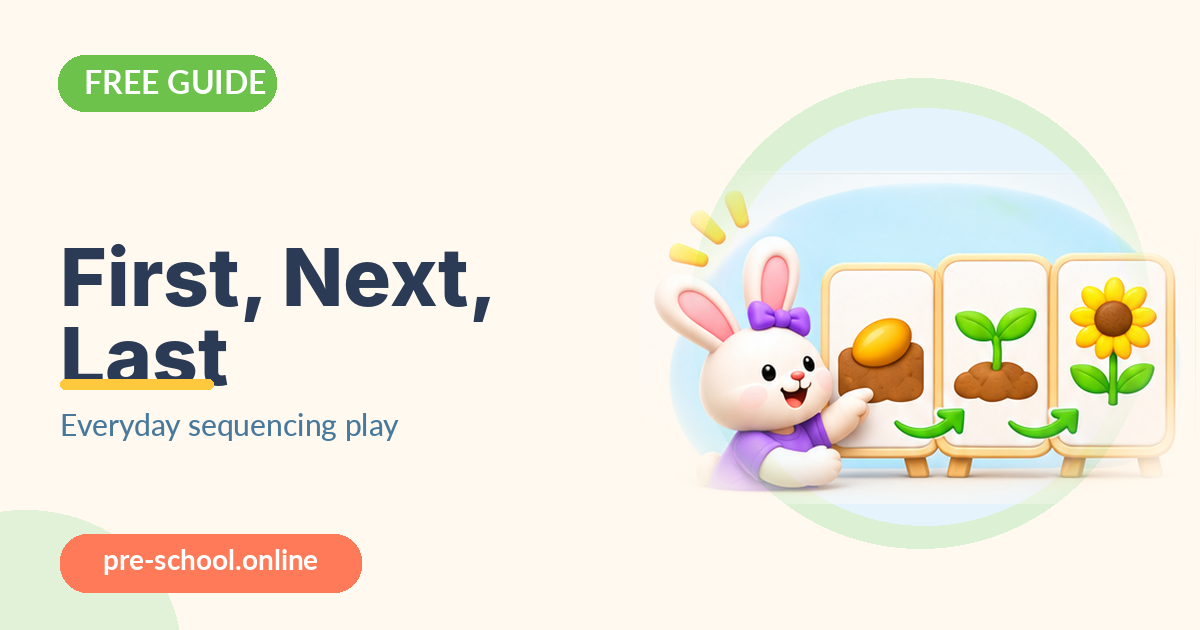
Before children can retell an involved story, they often start by putting familiar actions in order: first we wash our hands, next we dry them, last we eat. The words first, next and last help them describe routines, follow instructions and explain what happened.
These sequencing activities begin with real experiences before moving to pictures and stories. A three-year-old may need two steps; an older preschooler can arrange three or four and explain why one action comes before another.
- For parents and teachers
- Hands-on activities
- No expensive supplies
Key Takeaways
- Start with real routines the child knows, then represent those steps with large pictures.
- Use “first, next, last” during shared activities rather than only on a worksheet.
- Ask children to explain or demonstrate their order, not memorize a single picture sequence.
- Add more steps gradually and accept gestures, home languages or physical demonstrations.
In This Article
Understand the Goal
Sequencing is understanding that events happen in an order and describing that order. It supports daily independence, following directions, story comprehension and later planning or procedural thinking. A child who knows socks go on before shoes can use that meaningful sequence even if they cannot name all the printed words on a worksheet.
A sequence is not always fixed. Different families may prepare breakfast in different orders, and stories can unfold in several reasonable ways. Use the child's explanation and the task's actual logic to decide whether an order makes sense.
Important distinction: The aim is a useful experience, not a test score or a race to finish. Follow the child’s questions, pace, strengths and individual support needs.
What Makes This Work
Keep pictures simple and familiar. A blurry or ambiguous card can test picture interpretation more than sequencing ability. Start with a demonstration: brush, toothpaste, teeth; then invite a child to act out or explain the order. Ensure that personal routines respect the child's privacy, culture and abilities; not every child performs dressing or self-care tasks in the same way.
Printable worksheets are optional, not the foundation. Learning the order through real-world actions gives the pictures meaning. If the sequence is new, teach and practice the actual routine before expecting independent ordering.
Before beginning, choose a time when the child is reasonably rested, check that the materials and play space are age-appropriate, and demonstrate the first turn yourself. A child can take part by observing, pointing, moving an object, speaking, drawing or directing an adult; do not make verbal performance the price of participating.
Eight Practical Activities and Strategies
Start with one idea rather than attempting all eight in a single session. Revisit activities that capture the child’s interest, and keep the adult’s instructions shorter than the child’s play.
1. Show a two-step handwashing routine
Demonstrate 'First turn on the tap, next wash hands' while supervising water use. Add drying as the final step when the child understands the basic order. Use pictures of your actual sink when possible. Ask the child to point to the first picture, then act it out. Avoid racing or measuring how long a child takes to respond.
2. Put three snack pictures in order
Draw or print three large pictures: wash fruit, put it on a plate and eat it. Mix the cards and invite the child to arrange them. Ask 'What must happen before we eat?' If your family's routine differs, adapt the cards. Use clean, age-appropriate food with adult supervision and follow relevant food-safety and choking guidance; the card game does not require a real snack.
3. Build and rebuild a block tower sequence
Place one large block, then two, then three, and photograph or draw each stage. Ask the child to put the images in order from start to finish. Take the tower apart and invite the child to rebuild, describing what came first. This is useful for children who prefer concrete action before picture cards.
4. Tell a three-scene puppet story
Use a toy rabbit: first she loses her scarf, next a friend helps search, last she finds it. Let the child move the puppet while you narrate. Later offer three picture sketches and ask which scene happened first. If a child invents a different ending, celebrate the new story and compare it with the original rather than calling it wrong.
5. Sequence a familiar getting-ready routine
Ask the child to arrange a picture of finding shoes, putting them on and walking to the door. Explain that some children need help with shoes and that is okay. Older preschoolers can add the backpack step. Choose the actual order your family or classroom uses. The goal is comprehension of transitions, not the speed of dressing.
6. Make a first-next-last obstacle story
Set out three low, safe actions: step over a taped line, walk around a cushion and place a toy in a basket. Model the route before a child moves through it. Then ask them to show or describe what happened first, next and last. Offer a seated toy route for children with mobility needs. Keep furniture stable and do not add climbing hazards.
7. Use real photos from a simple craft
Photograph drawing a shape, coloring it and displaying the finished picture. Shuffle the images and let the child order them. Discuss why the final picture cannot be displayed before it exists. If a child does the craft in another order, use their real process. Sequencing should help explain events, not impose an arbitrary adult plan.
8. Invite the child to teach you a sequence
Ask the child to give an adult three directions for a game they know. Follow their directions literally but safely, and ask a clarifying question if the order is confusing. When children become the teachers, their choices reveal what they understand. Support with picture prompts rather than requiring a polished spoken explanation.
Try a related free resource: Explore activities for this skill. The resource is a follow-up to the practical steps above, not a replacement for them.
An Everyday Example
During a classroom routine, four-year-old Aisha struggles to remember what comes after washing hands. The teacher photographs three familiar moments: turn off tap, dry hands, sit at snack table. They look at the sequence together the next morning, and Aisha points to the second photo before she needs a verbal reminder. Several days later she tells a new child, 'First wash, then dry, last snack.' The pictures helped communicate a practical routine.
Notice how the adult makes the goal easier to reach: instead of requiring instant mastery, they make the next action clear, respond to the child’s idea and change the environment when needed. This same method works at home, with a small group or in a preschool learning center.
A Flexible Five-Day Practice Plan
This is an optional rotation, not a deadline. Repeat a successful invitation or skip a day when attention, energy or circumstances call for it.
| Day | Simple invitation | What to notice |
|---|---|---|
| Day 1 | Model a familiar two-step routine | Whether the child approaches with curiosity |
| Day 2 | Practice three snack or craft picture cards | How the child responds to the model |
| Day 3 | Sequence a block tower from photos | What words, actions or choices emerge |
| Day 4 | Retell a three-scene puppet story | Whether the child tries a new variation |
| Day 5 | Let the child teach an adult their own routine | Which activity they want to revisit |
Keep a learning note, if useful: Record a concrete observation such as “put the washing pictures in first-next-last order” rather than judging the child as ahead or behind. Use notes to choose another enjoyable invitation, not to create a new scoring system.
Adjust for Different Learners
For children who need a simpler start, use first/last and only two pictures. For children ready for extension, add 'before,' 'after,' 'finally' and 'because,' or invite different possible orders and explanations. Large, high-contrast photos can help children with visual needs, and tactile props may be more useful than print. A child using assistive communication can point to or arrange symbols instead of speaking.
Teachers can use photo sequences for class transitions while allowing individual schedules when necessary; the same words apply to different valid routines.
Children develop skills unevenly, and successful participation may look different from one child to another. If a concern persists across settings or affects everyday functioning, discuss your observations with the child’s caregivers, teacher or pediatric professional rather than trying to diagnose the child from an activity.
If Something Does Not Work
If pictures are put in an unexpected order, ask what the child thinks happens in each picture; perhaps the drawing is ambiguous. If a child guesses randomly, return to doing the routine together. If a child refuses the cards, use puppets or blocks instead. If the child remembers only 'first' and 'last,' keep practicing those words in real contexts before adding more complexity. Avoid making sequencing a high-pressure memory test.
Try changing only one feature at a time: simplify the materials, shorten the instruction, move to a quieter place, or let the child watch first. You will learn more from a calm retry than from insisting on the planned activity.
Frequently Asked Questions
At what age can preschoolers learn first, next and last?
Children can begin with familiar two-step routines and gradually use more sequence language during the preschool years.
Are sequencing worksheets necessary?
No. Real routines, toys, photos, crafts and picture books are often better starting points.
What if my child puts the cards in a different order?
Ask for their reasoning and check whether their order could make sense; not every everyday routine has only one valid order.
Can sequencing help with school routines?
Yes. Picture sequences and predictable language can make transitions and multi-step activities clearer.
Free Preschool Resources to Try Next
For a practical next step, start with the relevant resource below. These are existing Pre-School.online pages; the ideas in this guide can also be completed using everyday materials without visiting another page.
Sources and Further Reading
- Pre-School.online: Related Learning Resource
- NAEYC: Embracing Linguistic Diversity
- Reading Rockets: Print Awareness in Practice
This article offers general education guidance, not individualized developmental or medical advice. Supervise age-appropriate activities, follow manufacturers’ instructions and your school’s policies, and use qualified professional guidance for specific safety or developmental concerns.