
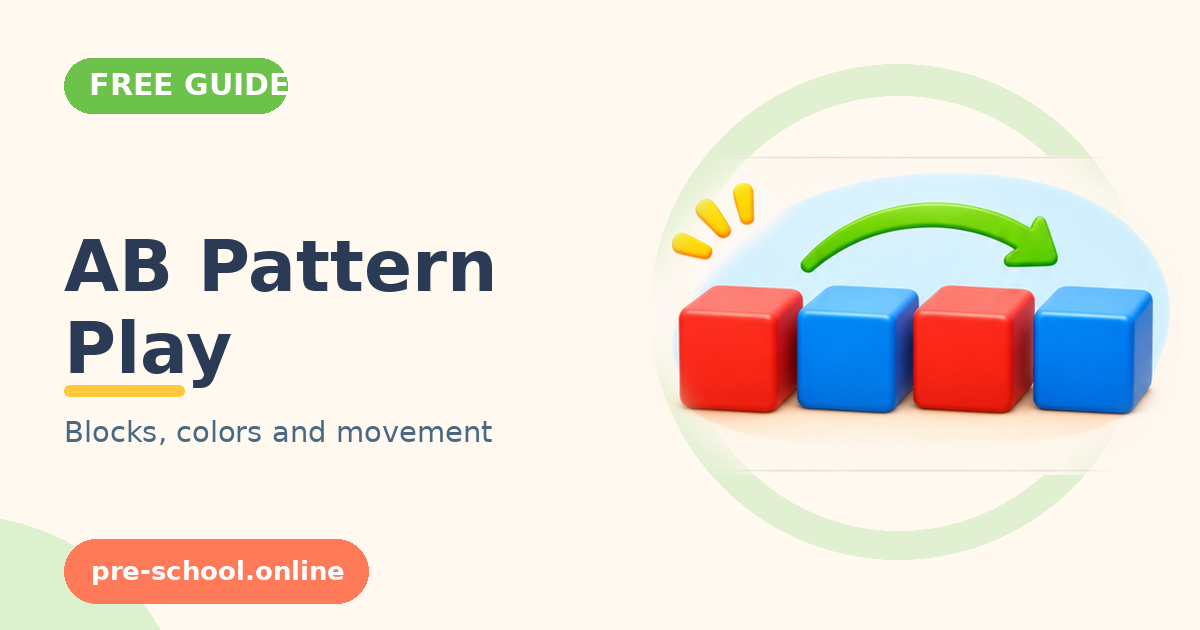
Red, blue, red, blue—what comes next? An AB pattern is one of the simplest repeating patterns preschoolers can explore. But seeing two colors is not the same as understanding that a unit repeats in order. Children learn that distinction by making, extending, checking and inventing patterns with large blocks, claps and movements. This guide gives you a gentle progression from copying a short sequence to explaining the repeating rule without turning pattern play into a worksheet race.
- Ages 3–5
- Practical parent & teacher ideas
- Free learning resources
Key Takeaways
- An AB pattern repeats a two-part unit: red–blue, red–blue, red–blue.
- Ask children to notice the smallest repeating chunk, not just guess the next object.
- Use big blocks, body movements and sounds to practice the same idea in different ways.
- Treat a broken sequence as a chance to test a prediction, not an error to punish.
In This Article
Understand the Learning Goal
Patterning involves order and repetition. Sorting puts all red blocks in one group; an AB pattern alternates red and blue repeatedly. This is why pattern activities deserve their own practice even when a child can already name colors. A child who says ‘red’ after blue may be following the visual cue, but the deeper idea is noticing that the two-color unit repeats.
Begin with large, easy-to-handle materials and give children time to notice the sequence. Describe it aloud: ‘red, blue; red, blue.’ Use a two-block ‘train car’ as the repeating unit so the child can compare one pair with the next. The Early Math Project describes pattern work as an early mathematical concept that children can extend and explain through hands-on exploration.
Eight Practical Activities and Strategies
Start with one manageable idea rather than attempting every activity in a single session. Model the steps, observe what your child enjoys and change the plan when circumstances or safety needs require it.
- Build a four-block pattern train
Lay out one red block and one blue block, then repeat them once: red–blue–red–blue. Say each color while pointing from left to right. Pause before offering another block and ask, ‘What do you notice?’ If the child adds an unexpected color, return to the first two and model ‘Our train has a red-blue pair that keeps coming back.’ Use four large blocks before moving to longer sequences, and keep extra pieces out of the way to reduce distractions.
- Reveal the two-piece repeating unit
Place two large paper squares around the first red-blue pair to show that the pair is one ‘pattern piece.’ Point to the second pair and ask whether it is the same. Invite the child to move the paper marker along the pattern. This makes the repeating rule visible. A child who can say the next color but cannot find the repeat may need this concrete step rather than another prediction question.
- Make the child the pattern builder
Give your child four large blocks and say, ‘Can you build a train that repeats two different colors?’ Let them choose the colors, even if they are unusual. Read the pattern together and ask what comes after the last block. If the child alternates in reverse order—blue-red-blue-red—that is still an AB pattern. Praise the rule they created, not whether they matched your model exactly. Younger children can copy a prepared train instead.
- Break a pattern on purpose
Build red-blue-red-red and ask, ‘Something changed; what happened?’ Give the child a chance to find the point where the order stopped repeating. Compare the first pair and the next pair rather than telling them the answer immediately. Then ask whether they want to fix it or invent a new repeating rule. This encourages checking a pattern as evidence, not simply repeating an adult’s color sequence.
Related free resource: Play Shape, Color & Pattern Games includes ideas you can explore after this article. Use only the parts that fit your child and your setting.
- Try movement patterns without materials
Stand in a clear area and model clap–pat–clap–pat. Say, ‘What comes after pat?’ Invite the child to lead. Adapt actions for seated play: touch the table, raise a hand, touch the table, raise a hand. Keep movements safe and comfortable, avoiding jumps on slippery flooring. A physical pattern lets children feel the repeating unit through movement, helpful when blocks are less interesting to them.
- Use two sounds to make an AB beat
Choose quiet sounds such as a gentle clap and a finger tap, then alternate them: clap-tap-clap-tap. Stop and ask the child to continue. If they have difficulty, create a two-symbol picture strip showing hands and a dot, or let them copy you without speaking. Keep the sound at a comfortable volume and offer silent gestures for noise-sensitive children. By changing from color to sound, children practice the same logical structure in a new form.
- Build a real-life pattern on a safe table
Alternate two types of large everyday objects such as blue and yellow cups, or a spoon picture and a plate picture. Avoid glass, sharp utensils and small beads. Ask the child where an object should go if the table gets longer. During cleanup, invite them to explain the rule to another person. The physical objects matter less than noticing the repeating order; do not require the child to write letters or numbers to demonstrate understanding.
- Compare AB with a new pattern only when ready
Once AB feels secure, briefly show red-red-blue-red-red-blue. Ask what is different about the repeating chunk. Do not expect every preschooler to master AAB immediately. You can return to AB and let the child invent one last example. The extension helps distinguish ‘a pattern’ from ‘alternating everything,’ while respecting that pattern reasoning develops gradually through repeated playful experiences.
A Realistic Everyday Example
During a small-group game, a teacher lays down large red and yellow blocks in this order: red-yellow-red-yellow. A child predicts red next, then says ‘it always goes red and yellow.’ The teacher circles the first pair with a paper frame and asks whether the next pair matches. When another child places two reds together, the group compares the pairs, moves one block and reads the fixed pattern aloud. The activity takes five minutes and reveals understanding of the rule, not just color naming.
Notice what the child actually did rather than grading the session: asking for help, testing an idea, showing a feeling, recovering from difficulty or choosing a safe next step. One meaningful observation can guide the next practice opportunity.
A Flexible Five-Day Practice Plan
Use these short invitations in any order and repeat a favorite if it still feels useful. Five days is a menu, not homework or a developmental deadline.
| Day | Try this | Gentle follow-up |
|---|---|---|
| Monday | Copy a four-block red-blue-red-blue train. | What did you notice? |
| Tuesday | Mark the repeating pair and say the rule aloud. | What would make this easier? |
| Wednesday | Let your child invent an AB block pattern. | Can you show me your idea? |
| Thursday | Make a clap–pat movement or sound pattern. | What could we try differently? |
| Friday | Spot and repair one broken sequence together. | Which part would you choose again? |
Related resource: Explore a complementary preschool resource when you want another suitable activity or story.
Adjust for Different Learners
For younger children, offer only two colors and prebuild the first two repetitions. Some children benefit from matching large picture cards to a guide. If a child has color-vision differences, use two obviously different shapes or textures; the learning goal is the order, not identifying red and blue.
For children ready to extend, ask them to represent the same AB rule using blocks, sounds and movements. Invite a more complex AAB pattern only when the simple repeating unit is understood. Encourage them to explain their choices using whatever language or gestures work for them.
When Things Do Not Go as Planned
If a child guesses the next block but loses the whole pattern, reduce it to two complete pairs and highlight the repeat. If they build AABB instead, acknowledge that they created a different repeating pattern and compare the units. Never use tiny beads, loose magnets or small counters when safe large pieces will do. When the activity becomes competitive or frustrating, step away and notice natural patterns in clothes, tiles or a familiar song instead.
Low-pressure reminder: If the activity is uncomfortable or unsafe, pause or stop. There is always another way to explore the underlying idea; a child does not need to complete every suggested step.
Frequently Asked Questions
What does AB stand for in an AB pattern?
A and B represent two distinct elements or actions that repeat in order, such as clap–tap–clap–tap.
Is red-blue-blue-red an AB pattern?
No, not as written. The simple repeating unit would need to appear in the same order again.
Does my child need to know color names first?
No. Use distinct shapes, sounds or movements; recognition of the repeating order is the key goal.
When should I introduce AAB or ABC patterns?
After the child understands and can extend a simple repeating unit, and only if they enjoy the added challenge.
Free Preschool Resources to Try Next
Continue with age-appropriate materials from Pre-School.online that directly relate to the learning goal. These resources complement the guidance here and do not replace adult support or safety supervision.
Play Shape, Color & Pattern Games Browse All Preschool Games
Sources and Further Reading
- Pre-School.online: Related Resource
- Early Math California: Classification and Patterning
- Pre-School.online: Shape, Color and Pattern Games
This article provides general educational information for parents, teachers, and caregivers. It is not individualized medical advice. Follow applicable safety guidance, local school rules, and qualified professional advice for specific developmental or health concerns.