
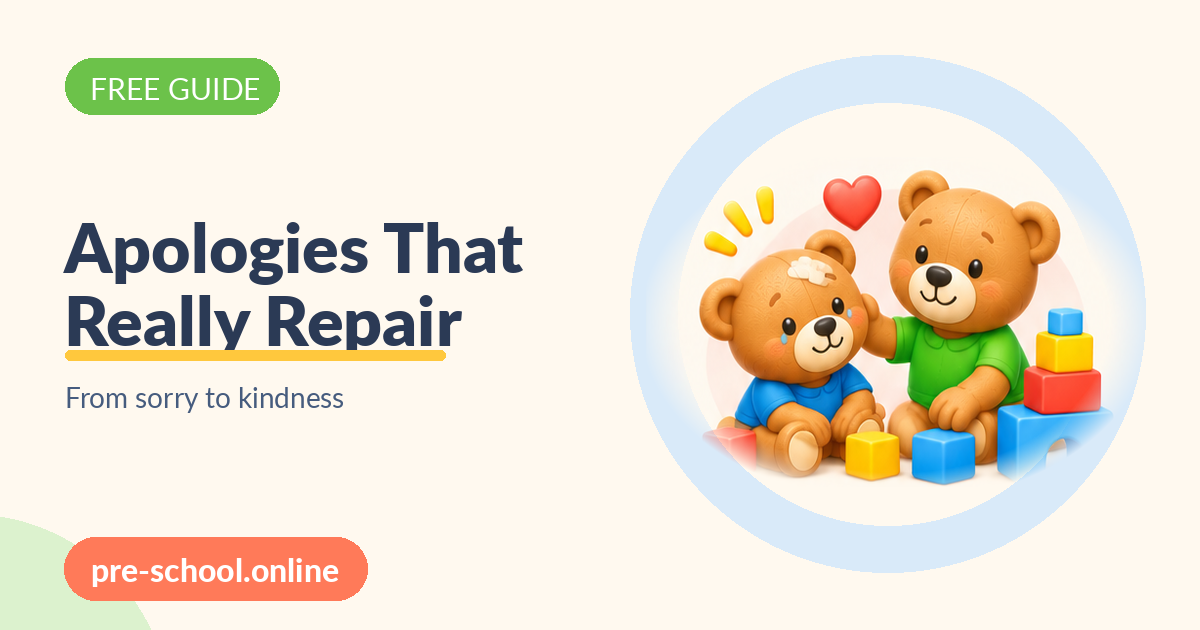
A rushed 'Say sorry!' may end a conflict for an adult without helping the children understand what happened. A meaningful apology is more than a word: it can include stopping the hurtful behavior, recognizing the other child's feelings, offering a realistic repair, and changing what happens next time. Preschoolers are still learning impulse control, perspective taking, and the language to do that. We can teach these steps without demanding affection, shame, or instant forgiveness.
- Ages 3–5
- Play-based
- Practical steps
Key Takeaways
- When a preschooler hurts someone, first make both children safe and calm. Briefly name what happened, help the child notice the other person's experience, and offer a specific repair such as returning a toy or helping rebuild. A spoken apology can be invited, but it should not replace the action or be forced in the middle of distress.
- Pick one manageable activity and adapt it to your child’s interests, language, and current abilities.
Why This Approach Helps
A toddler's automatic 'sorry' and a preschooler's emerging empathy are different things. Children may understand rules before they can reliably stop an impulse while excited or disappointed. Adults can model compassion and accountability in manageable steps: repair the situation first, practice helpful words later, and coach the replacement behavior. Never require a child to hug, touch, or accept an apology from another child; boundaries still matter.
The stages described below are invitations, not tests. You can model, shorten, repeat or adapt them for each child’s language, interests and support needs.
Seven Practical Activities or Steps
Begin with one step that fits your child and your setting. The suggested adult language is a model, not a script children must repeat word for word. Adjust the task before increasing pressure.
- Stop the behavior without assigning a bad identity
Move close, gently block another grab or hit, and separate the children if needed. Use neutral observations rather than labels such as 'bully' or 'naughty.' The goal is immediate safety, not a public lecture. If anyone is injured, give care and follow your school's incident procedures first.
Try saying: “I will not let anyone hit. We are stopping the game so everybody can be safe.”Make it easier or harder: For a very upset child, use fewer words and address the repair after regulation returns.
- Check in with the affected child first
Ask if the other child is okay and what support they need. Naming their experience demonstrates that the impact matters. Avoid rushing the child who was hurt into forgiveness; they can decide whether to return to play. This step also prevents the conversation from becoming centered entirely on the child who caused the problem.
Try saying: “That knocked your tower down. Are you hurt? Would you like help rebuilding?”Make it easier or harder: A nonverbal child may show what they need by pointing, moving away, or seeking an adult.
- State what happened in simple factual terms
When everyone can listen, describe the sequence: 'You wanted the truck, and you pulled it away while Ava was using it.' Avoid 'Why did you do that?' which often demands an explanation that a preschooler cannot provide. Separate the understandable wish from the behavior that still needs correction.
Try saying: “You really wanted a turn. Taking it from her hands was not safe or fair.”Make it easier or harder: Use a picture of the situation or act it out with toys when language is difficult.
- Build perspective with one small question
A child may not know what someone else feels. Help them notice an expression or action without insisting on a particular answer. 'He walked away after the blocks fell; I wonder if he is disappointed' is more useful than 'Look what you did!' The child learns to interpret cues rather than perform guilt for an audience.
Try saying: “How do you think he felt when the tower fell? I can help you notice his face.”Make it easier or harder: Offer two possible feeling words, or simply model one and move along.
- Offer two realistic ways to repair
Choose actions that fit the harm: return the toy, rebuild the block wall, offer a tissue, bring an adult, or ask what the other child needs. Let the child select from two achievable repairs. A repair is not buying forgiveness; the other child may still want space, and the adult should respect that choice.
Try saying: “You can give the truck back or help find a different truck while she finishes.”Make it easier or harder: For overwhelmed children, the adult can begin the repair and invite one small contribution.
- Invite words after an action—not instead of one
If the child is willing, model a brief statement that recognizes the behavior: 'I'm sorry I knocked down your blocks. Can I help?' If they are not ready to repeat it, model it yourself without forcing eye contact or physical closeness. A child may communicate accountability through action before speaking comfortably.
Try saying: “I knocked down your blocks. I can help rebuild.”Make it easier or harder: Accept a gesture, drawing, or cooperative repair if spoken language is not accessible in that moment.
- Rehearse the next-time skill with dolls
Later, use a two-minute pretend-play scene where two stuffed animals want the same object. Practice saying 'My turn next, please' or asking an adult for help. Reinforce the replacement strategy when you see it in real play, even if it was a small success. Frequent rehearsals are more useful than repeating 'say sorry' after every conflict.
Try saying: “Teddy wants the car. What could Teddy say before reaching for it?”Make it easier or harder: Let a child who dislikes role-play watch you model two options first.
A Worked Example You Can Try
Two children reach for the same blue truck. Leo grabs it and Mina cries. The teacher crouches: 'I won't let you grab. Mina, would you like your truck back or help finding another place to play?' Leo returns it. After a brief calming pause the teacher says: 'You wanted a turn. Next time say, “Can I use it when you're finished?”' The class later practices with puppets. Leo does not need to recite an apology on demand for the repair to count; he needs a supported opportunity to change the next interaction.
At Home and in Preschool
For classroom practice, establish one shared rule about safe hands and returning materials. Train adults to respond consistently: protect the child who was hurt, name the behavior, offer a repair, and coach a better request. At home, narrate your own mistakes: 'I spilled the water. I will clean it up.' Such ordinary examples show that accountability is a behavior adults practice too, not something children must perform perfectly.
Watch for small changes: the child pauses before grabbing, accepts a repair option, or independently asks a peer what would help. Repeated hitting or distressed behavior deserves a coordinated support plan that considers triggers, communication, and environment; moral lectures alone will not teach missing skills.
Adjustments for Ages Three to Five
Ages are approximate guideposts. Different children may need different supports, and progress does not need to follow a single timetable.
| Stage | Helpful adjustment |
|---|---|
| Around age 3 | Start with safety, simple labels such as sad or hurt, and one concrete repair chosen with adult help. |
| Around age 4 | Invite a brief description of the action and two possible fixes; practice requesting turns during calm play. |
| Around age 5 | Encourage children to notice the impact, offer their own repair idea, and revisit the plan after the conflict. |
Common Pitfalls and What to Do Instead
When a child disengages or becomes frustrated, it is often better to change the task or offer support than to repeat the same demand.
| Avoid | Try instead |
|---|---|
| Forcing a scripted sorry immediately | Support regulation, name what happened, and invite repair before optional apology words. |
| Asking for a hug or instant forgiveness | Respect both children’s bodily autonomy and the harmed child’s right to space. |
| Only asking the child who caused harm how they feel | Attend to the affected child first and check for injury or distress. |
| Assuming one apology fixes a recurring pattern | Practice skills proactively and seek individualized support when conflicts are frequent or unsafe. |
Frequently Asked Questions
Should I always ask a child to say sorry?
You can offer and model an apology, but the teaching goal is understanding impact and repairing harm—not repeating a phrase to end adult discomfort.
What if the other child does not accept the apology?
That is okay. Acknowledge the boundary, complete any necessary repair, and give both children time.
What if my child laughs while someone is upset?
Laughter can reflect nervousness or dysregulation, not necessarily cruelty. Address the behavior and practice recognizing feelings when calm.
Free Preschool Resources to Try Next
Explore play-based social and emotional activities that build kinder choices. Choose what actually fits the child’s needs; you do not need to finish a collection in one sitting.
References and Further Reading
These resources support the educational approach and offer optional next steps. Only existing, relevant resources on Pre-School.online are linked above.
Sources
This article shares general educational guidance for preschoolers. Follow current product instructions and official safety information where relevant; educational activities do not replace individualized developmental, medical, or professional advice.