
Free practical guide · Ages 3–5 · Early Learning Skills · PSB-0243
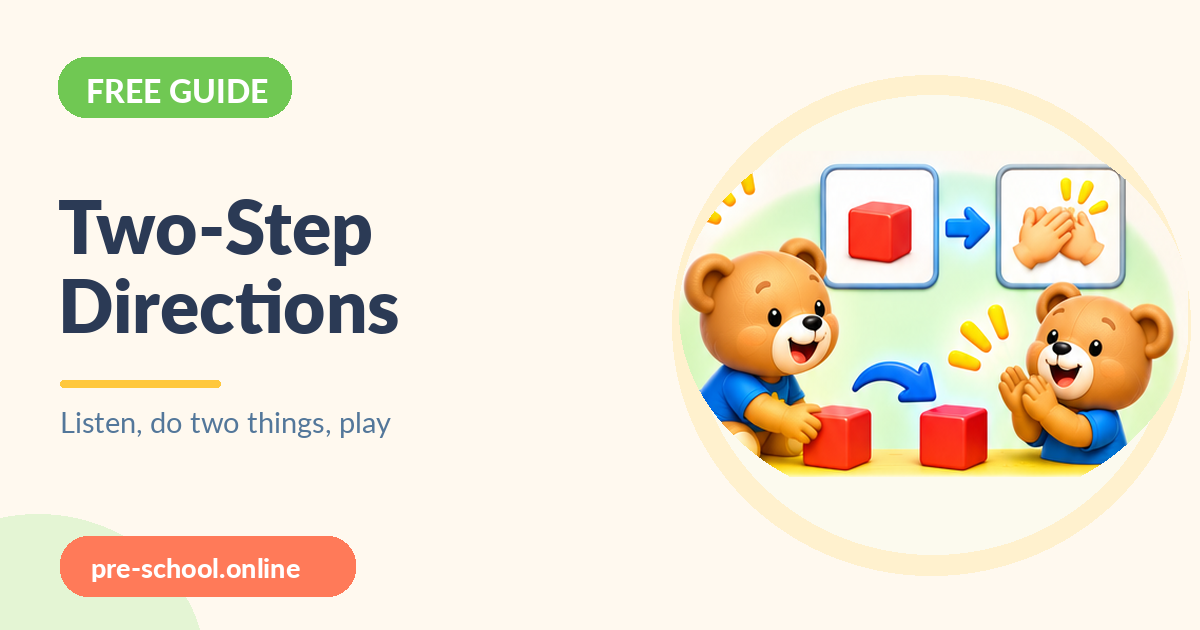
“Pick up the block and put it in the box” sounds straightforward to an adult, but it asks a preschooler to listen, remember an order and do two actions. The child might understand each action separately yet miss the second one when they are excited, tired or surrounded by noise. You can build the skill through playful routines rather than testing compliance.
Two-step direction games are most useful when the words are familiar and the task gives immediate feedback. Adults often make directions accidentally harder by adding extra commentary: “Put that away, and then when you finish maybe grab…” Keep the actions clear and short. A child who follows a sequence one day and needs reminders another day may simply be working in a different context.
- For families and preschool educators
- Hands-on and age-appropriate
- Adaptable for real classrooms
Key Takeaways
- “Pick up the block and put it in the box” sounds straightforward to an adult, but it asks a preschooler to listen, remember an order and do two actions.
- Prepare a few large toys, an open box and space to move.
- Following directions is not the same as instantly obeying every adult request.
Why This Approach Matters
Two-step direction games are most useful when the words are familiar and the task gives immediate feedback. Adults often make directions accidentally harder by adding extra commentary: “Put that away, and then when you finish maybe grab…” Keep the actions clear and short. A child who follows a sequence one day and needs reminders another day may simply be working in a different context.
Starting point: A useful preschool activity should make room for the child to look, move, talk, point, draw or participate in another accessible way. Adults can model once and then adjust the activity instead of increasing pressure.
Before You Begin
Prepare a few large toys, an open box and space to move. Start with one-step success and only then add a second action. Face the child, reduce competing noise, use familiar verbs and give enough processing time. Keep safety instructions separate: for urgent safety, adults must physically intervene rather than expect a game skill to protect a child.
Eight Practical Activities and Strategies
1. Use a familiar action plus a second familiar action
Begin with “Touch your head,” then, once that is comfortable, try “Touch your head and clap.” Pause before repeating. The child needs to remember sequence, not decode unfamiliar words. Let children choose their actions too, such as “Jump once and wave,” provided movement is safe and accessible.
2. Make a toy delivery game
Set out two large, safe objects and a wide basket. Say “Take the bear and put it in the basket.” Later use “Pick up the blue car and place it next to the bear.” Do not pile on color, position, and movement demands at once. Ask the child to show the action rather than prove they can repeat every word.
3. Teach “first” and “then” with pictures
Draw two quick symbols: shoes and door. Say “First put on shoes, then come to the door.” Move a finger from the first picture to the second while speaking. Use the same format across familiar routines. Gradually fade the pictures only if the child no longer needs them; visual cues are legitimate supports, not cheating.
4. Play a cooperative follow-the-leader game
One player asks for two actions: “Tap the floor, then stand tall.” Everyone performs them, and nobody is eliminated for forgetting. Switch leaders so children practice making clear directions as well as following them. For large groups, use quiet gestures so instructions do not become a competition to be fastest.
Free related resource: For additional ways to practice, explore Pre-School.online’s relevant early learning skills resource. The steps in this article can be used on their own.
5. Build a two-step pretend shop
The child is the shopkeeper. Say “Find one apple and put it in my bag.” Then switch roles and let the child order something from you. Use large pretend food or clean, safe empty packages without detachable sharp parts. This makes the sequence meaningful: the second action completes a small story.
6. Use clean-up as practice, not a power struggle
Offer one pair of actions: “Put the blocks away, then bring the basket to me.” Stand nearby to help. Avoid turning a rushed transition into a test of attention; if a child is overwhelmed, reduce it to one step and finish together. Consistent language at a predictable time builds comprehension without a prize or punishment.
7. Add a simple listening-and-memory rhythm
Clap once and then tap your knees. Say the steps aloud the first time; after several repetitions ask children to copy. Use two beats with a pause, then invite them to propose a new pattern. A seated or hand-only version works for children who cannot jump or stand. Listening and movement reinforce one another.
8. Notice when a direction is too complicated
If a child regularly misses one part, identify which demand is hardest: hearing, knowing the words, keeping the order, or shifting attention. Repeat calmly with a gesture and ask whether the child understood. Instead of saying “You never listen,” adjust the task and share ongoing concerns with the child’s teacher or healthcare provider if they occur across contexts.
At Home and in the Classroom
At home
Practice with setting the table, putting two toys away or following a tiny recipe sequence. Begin at a relaxed time, not when everybody is already late. Use the same “first/then” words each day so the child can predict the pattern.
In preschool or a group
Try one two-step challenge with a small group and use picture prompts. Keep requests brief enough for the noise level. Include children who communicate with gestures or AAC, and do not require everyone to respond at the same speed.
In either setting, watch for engagement and comfort. If an activity creates pressure or becomes too complex, offer a smaller entry point and revisit it another day. Learning through play can be both purposeful and responsive.
Worked Example: What It Looks Like
A teacher says, “Take your coat, put it on the hook, go to the rug and sit quietly.” Three children wander away. She changes the wording to “Hang up your coat, then come to the rug,” showing a coat-and-rug picture. One child follows both steps; another completes the first only. She waits and points gently to the rug picture. The child completes it. This is responsive instruction rather than a behavior rating.
Notice the adult response: The activity changes when the situation changes. Supporting a child’s thinking, communication or safety matters more than completing a preset script exactly.
A Flexible Five-Day Plan
This plan is a menu, not a set of milestones to pass. Spend a few minutes on the invitation each day, repeat an activity the child enjoys, and choose the safest materials available in your setting.
| Day | Try this |
|---|---|
| Monday | Practice three easy single actions and one familiar two-action sequence. |
| Tuesday | Deliver toys to a basket, gradually changing only the object, not the entire sentence. |
| Wednesday | Follow a first/then picture routine during a calm transition. |
| Thursday | Let the child become the leader and give you two safe actions. |
| Friday | Play a cooperative listening game, then note which visual or verbal support helped most. |
At the end of the week, note one thing the child asked about, tried, changed or explained. These observations help adults plan the next invitation without assigning grades to preschool play.
Adaptations and Accessibility
- Use two picture cards or clear gestures if speech-only instructions are hard to process.
- Offer extra response time for children who need it; do not talk over the pause.
- Teach and accept the child’s home language where possible.
- For a challenge, add a location word only after two-step sequencing feels familiar.
Follow individualized education, communication, sensory or health plans when relevant. A child’s home language, culture and preferences should shape participation rather than be treated as obstacles to learning.
What Matters Most
Following directions is not the same as instantly obeying every adult request. It includes comprehension, memory, motivation and a safe relationship. Game success does not rule out hearing, language or developmental concerns; persistent difficulty warrants individualized discussion rather than a self-made diagnosis.
When Things Do Not Go to Plan
If a child guesses the second action, slow down and point to a picture. If the game becomes frustrating, return to one step for that session. If the child can do two steps while playing but not in a noisy classroom, change the sound environment. Praise the effort to remember rather than comparing children.
Frequently Asked Questions
At what age should a child follow two steps?
Abilities vary. Use age-appropriate milestones as discussion guides, not rigid pass/fail rules. A child’s clinician or educator can help if concerns are persistent.
Should I repeat the directions until they listen?
Try a brief pause, a gesture and simpler wording. Repeating a long sentence rapidly often makes the task harder.
Can the child give me instructions?
Yes. Being the leader supports planning, expressive language and understanding the structure of a sequence.
What if the child follows two steps only sometimes?
Consider the environment, fatigue, interest and clarity of your directions. Notice patterns across days before concluding a skill is missing.
Explore Free Preschool Resources
Use these Pre-School.online pages when they fit your child’s questions and your available time. The practical steps above are complete without needing to buy a kit or click away.
Explore the matching free activitiesSee another relevant resource
Sources and Further Reading
- Pre-School.online: Listening Games
- Head Start: Early Learning Outcomes Framework
- CDC: Developmental Milestones
- Pre-School.online — Matching Preschool Resource
Editorial learning guide for families and educators. Educational information is not individualized medical, developmental, emergency or product-safety advice; follow applicable program policies and qualified professional guidance.