
Free practical guide · Ages 3–5 · Early Learning Skills · PSB-0255
A preschool weather lesson can begin with one question: 'What is the sky doing today?' Observing clouds, shadows, wind and temperature over time gives children real evidence to compare. You do not need to teach climate science or ask a child to memorize season names before they are ready.
Repeated observations support noticing change, describing evidence and comparing experiences. Seasons look different in different climates, so a useful curriculum connects weather words to the local environment instead of assuming every child sees snow or autumn leaves. A chart is a record of shared discoveries, not a test of right answers.
- For parents and preschool educators
- Practical and play-based
- Adaptable for ages 3 to 5
Key Takeaways
- Repeated observations support noticing change, describing evidence and comparing experiences.
- Prepare a four-picture weather card, pencil, window view and large calendar sheet.
- Observe what is real and local; describing evidence matters more than a memorized season chart.
Why This Approach Matters
Repeated observations support noticing change, describing evidence and comparing experiences. Seasons look different in different climates, so a useful curriculum connects weather words to the local environment instead of assuming every child sees snow or autumn leaves. A chart is a record of shared discoveries, not a test of right answers.
What to notice: Watch for a child’s choices, gestures, questions, attempts and moments of connection. A child’s understanding is not measured by completing every step or giving a perfect answer.
Before You Begin
Prepare a four-picture weather card, pencil, window view and large calendar sheet. For outdoor observations check local forecasts, air-quality alerts, sun exposure and thunderstorms; never send children outside to inspect dangerous weather. Use dry indoor alternatives whenever weather is unsafe. Keep all demonstrations low-tech, short and child-led.
Start small: Choose one idea that fits your child and setting. Give a brief demonstration, allow a choice and stop if the experience becomes unsafe or distressing.
Eight Practical Activities and Strategies
1. Make the same sky check at the same time
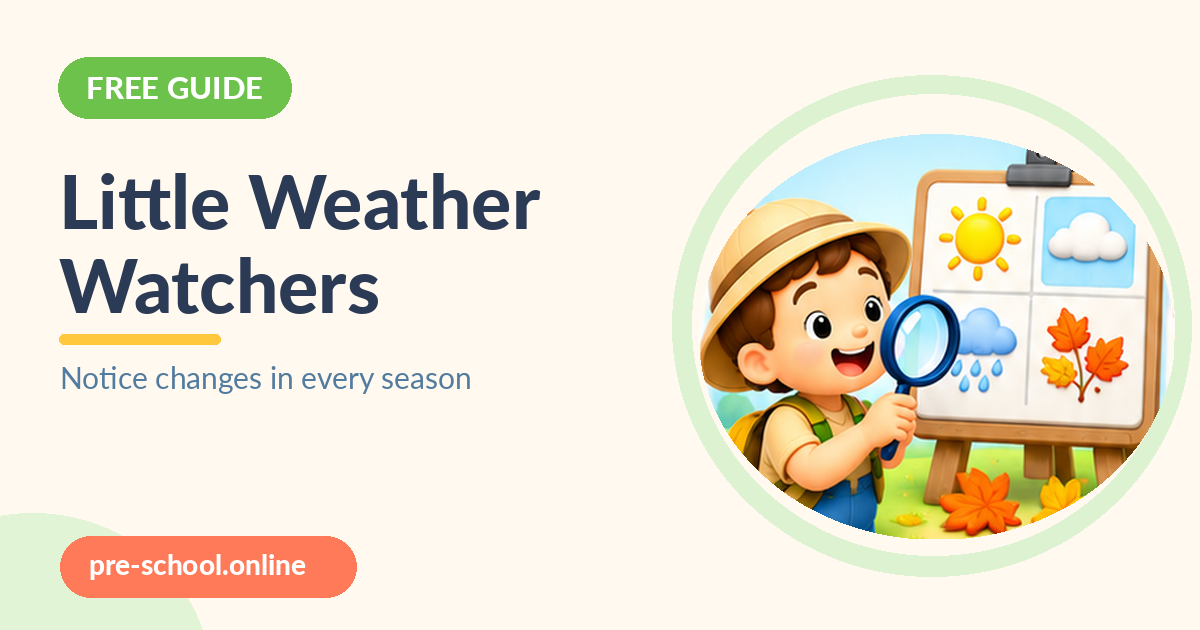
Invite your child to look safely through a window each morning and choose a sunny, cloudy, rainy or windy picture. They may point, say a word or gesture. Record one symbol and move on. Repeat for several days to build a familiar routine; the goal is to look closely rather than accurately predict tomorrow's weather.
2. Compare shadows across a day
On a safe, sunny day, notice a tree or building shadow from a shaded location. Check again later and compare whether it looks longer, shorter or in a new place. Never instruct children to look directly at the sun. If you cannot go outside safely, use a desk lamp operated by an adult to make moving paper shadows indoors.
3. Feel wind without facing extreme conditions
Observe how a wide paper streamer moves when an adult fans it inside. Outside, notice leaves moving from a safe location. Ask, 'What is moving even though we cannot see the air?' Do not use a strong fan close to children's faces or open windows with fall hazards. Keep the experiment gentle and optional.
4. Build a temperature word bank
Use comfortable, familiar words—warm, cool, chilly, hot—before introducing numbers. Talk about how clothing changes with the weather, but note that families in different places dress differently. If using a thermometer, an adult reads and handles it. Never leave liquid or glass thermometers available for play.
Free related activity: Continue with the matching Pre-School.online resource. Use the article’s instructions even when you do not need additional printable materials.
5. Compare two weather days with picture marks
Put Monday and Tuesday pictures side by side and ask what changed. Model evidence-based talk: 'Yesterday we saw clouds; today I can see sunshine.' A child might notice the playground is wet or the room feels bright. Accept those observations. Older preschoolers can count how many days of the week shared the same weather symbol.
6. Connect weather to local seasons
Invite families to share how their community marks rainy, dry, cool or windy times. Some regions have little snow; others have monsoon or wet/dry seasons. Use photographs from trusted sources when local experience does not include a familiar textbook season. Avoid claiming one season always follows a particular temperature everywhere.
7. Make a forecast and check it gently
Ask, 'What do you think the sky will look like after lunch?' Point to two possible cards, then revisit the window. Whether the prediction matches does not determine success. Say, 'We thought it would stay sunny, but the clouds arrived.' This models how observations can change our ideas.
8. Build a child's mini weather report
Let your child choose one word, a gesture and a picture to share with a family member or small group. For example, 'cloudy, cool, I wore a jacket.' Another child can ask what they noticed. Keep reports brief and low pressure, and remember that describing today's conditions is different from promising an accurate weather forecast.
At Home and in the Classroom
At home
Place two weather picture cards near a window and talk during breakfast. One observation daily beats an elaborate chart that is never revisited.
In a preschool group
Invite a rotating weather reporter to choose a picture, with a peer helping add it to the chart. Offer sign, pointing and AAC options to include every child.
In either setting, participation may be spoken, gestural, drawn or shown through movement. Keep the learning invitation useful for children who need a shorter activity, a familiar partner or a quieter environment. A responsive adult changes the plan when needed.
Worked Example: What It Looks Like
A class compares three mornings. Monday is sunny and children notice a long shadow; Tuesday is cloudy with no obvious shadow; Wednesday is windy and paper strips flutter indoors. They add three picture cards to a chart and explain what changed, building a record from firsthand evidence instead of memorizing a list.
Adult reflection: Which moment showed attention or curiosity? What was hard? What could you simplify next time? Keep notes about the experience rather than labeling the child as successful or unsuccessful.
A Flexible Five-Day Plan
Use the five-day plan as a menu, not an assignment. Most activities can be shortened to five or ten minutes, repeated when your child is interested, or replaced with a safer alternative. Invite the child to choose a favorite activity again before adding something new.
| Day | Try this |
|---|---|
| Monday | Look through a safe window and mark a sky symbol. |
| Tuesday | Compare shadows or indoor lamp shadows without looking at the sun. |
| Wednesday | Observe wind using a wide paper streamer indoors. |
| Thursday | Place two weather pictures side by side and discuss changes. |
| Friday | Give a mini weather report in words, gesture, drawing or AAC. |
At the end of the week, note one concrete example of what the child noticed, communicated, tried or changed. Do not assign grades to preschool play, and avoid comparing siblings or classmates.
Adaptations and Accessibility
- For younger preschoolers, offer two choices, one simple action and a short modeling turn before expecting independent participation.
- For emerging communicators, accept gestures, home-language words, picture cards, sign language, AAC or movement as meaningful responses.
- For children sensitive to noise, touch or crowds, use a smaller group, a quieter setting and predictable transitions; do not force sensory contact.
- For children seeking more challenge, invite a comparison, explanation or child-designed variation rather than adding repetitive worksheets.
Follow individualized education, therapy, communication or health plans when relevant. When a child repeatedly struggles with a skill across contexts, a teacher or pediatrician can help decide whether individualized support is appropriate.
What Matters Most
Observe what is real and local; describing evidence matters more than a memorized season chart.
The purpose of these ideas is to support real learning and real relationships. A preschooler can benefit from an activity even when the materials, order, duration or final result look different from the adult’s plan. Safety and belonging come first.
When Things Do Not Go to Plan
If the sky looks the same for a week, look for another observable detail: shadows, wind or clothing. If seasons do not match a poster, trust your local environment. For lightning, smoke, high heat or poor air quality, observe only from a safe indoor place or use archived pictures.
If a planned activity fails, make one thoughtful adjustment rather than increasing pressure: lower the number of instructions, change the time, offer visual support, reduce group size or revisit a known favorite. Continue to supervise closely and remove any damaged or age-inappropriate materials before trying again.
Frequently Asked Questions
Should preschoolers memorize all four seasons?
They can learn the names over time, but observing real local weather and using descriptive language is a better starting point.
Can a classroom weather chart be inaccurate?
Yes, children may disagree about what they see. Discuss the evidence and treat the chart as a shared observation record, not a graded assessment.
What if there are no obvious seasonal changes?
Study changes in cloud cover, rainfall, daylight, shadows, clothes or plants, and use local patterns rather than a generic northern-climate sequence.
Can we observe thunderstorms outdoors?
No. If thunder is heard or lightning seen, move into a safe enclosed shelter and follow local weather warnings.
Continue With Free Preschool Resources
This guide works by itself. When you want another activity, explore the directly relevant free resource below and choose a suitable, supervised option.
Explore a Related Free Preschool Resource
Explore preschool science and nature activities. Keep learning playful and adapt the instructions to your child.
Explore preschool science and nature activitiesOther useful pages
Sources and Further Reading
Editorial references used to check the educational or safety guidance in this article:
This article provides general educational information and does not replace individualized advice from your child’s teacher, pediatrician, or another qualified professional. For safety incidents or emergencies, seek appropriate immediate help.