
Home › Blog › Screen-Free Play
A preschooler who builds the same tower every day is already experimenting. Which block balances? How high can the wall go? What happens when the base is too narrow? Adults can nurture that curiosity by offering a small engineering problem instead of prescribing a perfect finished model. Block challenges invite children to plan, test, revise, and explain their ideas using materials they already enjoy.
Short answer: Give one clear building challenge, a safe set of age-appropriate blocks, and permission to experiment. Ask what the child notices when the structure succeeds or falls, then offer a new question—wider, taller, stronger, longer—instead of fixing it for them.
Key Takeaways
- A challenge is a playful invitation, not a competition for the tallest tower.
- Ask children to predict, build, test, and change one variable at a time.
- Use counting, shape, position words, and storytelling naturally during play.
- Choose large, undamaged parts and supervise closely; avoid hazards from tiny pieces or unstable high structures.
Understand the Skill and Set Up for Success
Block building supports opportunities for spatial language, early mathematics, cooperation, and problem solving. These skills emerge through the child’s actions: arranging two blocks, noticing a gap, or rebuilding after a collapse. A grown-up can prompt thinking without immediately demonstrating the ‘best’ solution.
Before you start, inspect all blocks, choose a stable floor or low table, and keep a safe building height. Avoid loose magnets, tiny connectors, heavy objects above a child’s head, and cluttered walkways. For mixed-age play, use the larger blocks appropriate for the youngest child with access.
Use the child’s interests and abilities to guide the next step. The activities below are flexible invitations rather than tests, and adults can model, join in, or shorten the challenge whenever needed.
For a relevant, free follow-up on our site, see Explore preschool building and construction toys. Use one suitable activity rather than trying to complete a whole collection at once.
Hands-On Activities to Try
Each idea below includes a specific action, words an adult can use, and an adjustment for a child who needs a simpler or more challenging starting point. Pick what fits your setting; you do not need to do everything in one session.
- Build a bridge for a toy car
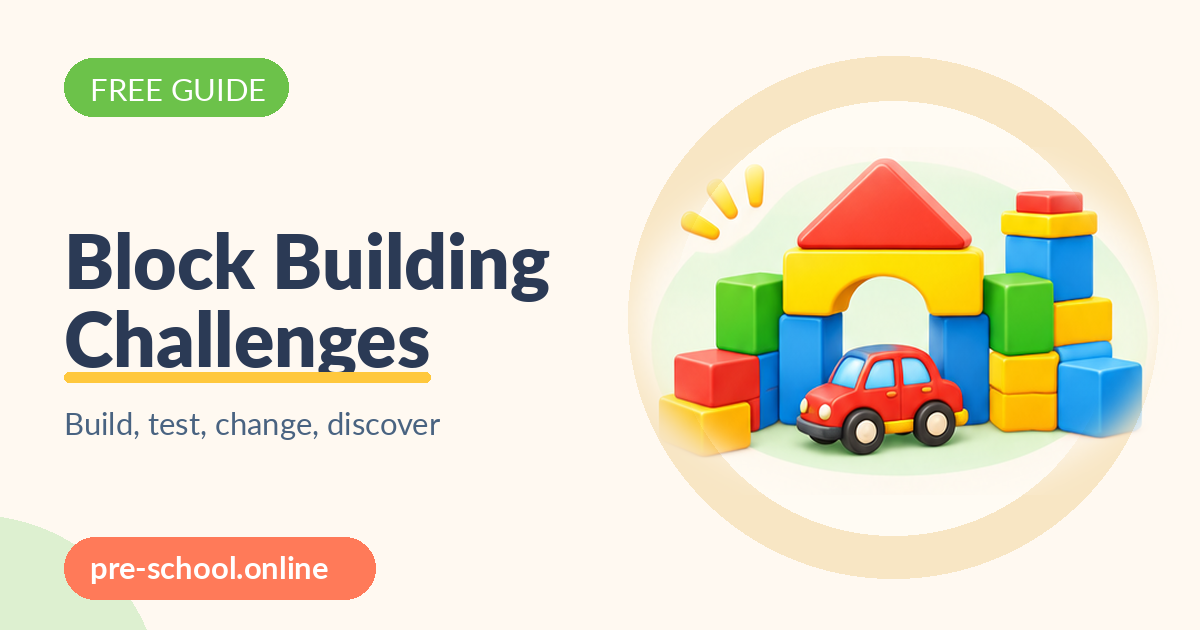
Place two sturdy blocks apart and challenge the child to span the gap with another block. Roll a large toy car beneath or across it. Ask what happens if you move the supports farther apart, and let the child discover when a bridge stops working.
Try saying: ‘Can your bridge hold the car while leaving a tunnel underneath?’
Adjust it: Start with a narrow gap for beginners, then measure span using identical blocks.
- Make a stable tower
Offer a selection of broad and narrow pieces. Build a tower, give it a gentle supervised test, and observe the base. Instead of racing for height, ask how changing the bottom layer affects stability.
Try saying: ‘Your tower leaned. What happens if the wider block goes underneath?’
Adjust it: Keep towers low and away from faces, and never encourage climbing on them.
- Create a repeating color road
Use two large block colors to build a red-blue-red-blue path. Drive a toy along the pattern while saying the sequence. When it is familiar, try an AAB pattern such as red-red-blue.
Try saying: ‘Red, blue, red, blue. Which block would you pick next?’
Adjust it: Use shape or size patterns if the child does not distinguish colors easily.
- Make a garage that fits
Choose a big toy vehicle and ask the child to build a garage around it with enough room to park and drive out. Talk about taller, wider, inside, beside, and through.
Try saying: ‘Does the car fit? What could you change to make the doorway wider?’
Adjust it: For a younger child, build only two walls and celebrate the opening.
- Build a neighborhood from boxes
Combine large cardboard boxes and chunky blocks to create a road, library, and home. Invite the child to assign roles and tell a story about the neighborhood. This expands construction into rich language and pretend play.
Try saying: ‘Where will the bus stop? Who uses this building?’
Adjust it: Use drawn roads on paper instead of floor tape if adhesive surfaces are unsuitable.
- Experiment with a toy ramp
Rest a rigid board safely on a low block to form a gentle ramp. Roll a large, safe toy car from the same starting point, then change the height slightly and observe. Keep away from stairs and other fall hazards.
Try saying: ‘Did the car go farther this time? What changed about our ramp?’
Adjust it: Use two different ramp heights and a chalk mark rather than chasing speed.
- Design a team-built wall
Give two children complementary tasks: one chooses the base pieces; the other adds blocks; then switch. Practice asking ‘What should we do next?’ and repairing a wall after an accidental knock without blaming anyone.
Try saying: ‘Your ideas both helped. How can we make the wall stronger together?’
Adjust it: Have adults model one turn with the child before pairing peers.
- Build from a picture clue
Draw a simple arrangement of three or four blocks on paper. Invite the child to recreate it, discuss where each piece goes, then let them change the design. The picture should be a jumping-off point, not a compulsory worksheet.
Try saying: ‘The picture has two blocks underneath. What do you notice about your build?’
Adjust it: Remove one block from the picture for beginners; invite older children to draw their own clue.
- Find the strongest doorway
Make two doorways: one with narrow supports, one with wider supports. Place a lightweight block gently on top and compare. Emphasize observation instead of collapse theatrics or balancing heavy objects.
Try saying: ‘Which doorway stays open when we add a small roof?’
Adjust it: Keep load blocks soft and light, and test only low structures.
- Invent a build-and-tell story
Ask the child to build something, choose a name for it, and explain how it works. You can write down their exact sentence or take a photo for family discussion. Storytelling is part of the learning, not an add-on reward.
Try saying: ‘Tell me about your bridge. Who uses it, and what problem does it solve?’
Adjust it: Accept pointing, gestures, and acting out as valid ways to tell the story.
A Worked Example You Can Try Today
A practical 15-minute mini-lesson: two minutes choosing safe blocks and a challenge; five minutes building; three minutes testing and changing one feature; three minutes telling a story about what was built; and two minutes cleaning up together. If the child is deeply engaged at minute ten, let the project continue. The timetable is for adults, not a demand on the child.
Keep a notebook of children’s questions—’Why does the bridge fall?’ or ‘How can the house fit two animals?’—and revisit one later. Avoid claiming a child has mastered engineering because one structure stands; the value is repeated observation and discussion.
Look for small signs of engagement, problem solving, and emerging independence. A child who asks for help, tries a new strategy, notices a detail, or returns to the game later is showing meaningful participation—even when the result is not polished.
Using These Ideas at Home and at Preschool
For home play, a few chunky blocks and a toy car are enough. In a classroom, use designated construction areas with clear floor space; provide pictures of bridges and local buildings to extend children’s ideas, not to prescribe the result. Invite girls and boys equally into spatial tasks and group leadership.
How to Adapt for Different Ages and Needs
Ages are approximate guideposts, not pass/fail criteria. Choose the level that makes the child feel supported while offering a manageable next challenge.
| Stage | Practical adjustment |
|---|---|
| Around 3 | Stack broad blocks, fill and empty containers, and make simple paths with adult supervision. |
| Around 4 | Build a bridge, extend a color pattern, and use position words during play. |
| Around 5 | Predict what a structural change might do, compare results, and explain a design choice. |
Common Pitfalls and Better Alternatives
When an activity stalls, a simpler plan or a safer environment usually helps more than repeating the same instruction louder. Consider these common trouble spots.
| Common pitfall | What works better |
|---|---|
| Adult rebuilding every mistake | Ask what the child notices and offer a hint; let them revise. |
| Overcomplicated instructions | Give one constraint and a choice of materials. |
| Towers that are too high or heavy | Keep builds low, light, and away from faces and walkways. |
| Small pieces around younger children | Use oversized blocks in mixed-age spaces; inspect for loose components. |
Frequently Asked Questions
Do I need special STEM kits?
No. Large blocks, a toy car, a cardboard box, and thoughtful questions are enough.
What if my child knocks towers down constantly?
Treat it as information about cause and effect, set a safe knock-down area, and encourage rebuilding with low soft blocks.
Are block challenges suitable for groups?
Yes, when tasks have cooperative roles and materials are safe for every child present.
Free Preschool Resources to Try Next
Continue the skill with these existing Pre-School.online guides and activities. Choose the resource that answers the particular problem you are working on instead of adding extra tasks for their own sake.
Explore preschool building and construction toys Try Month 9: Things That Go and Build It
Related Resources and Sources
- Explore preschool building and construction toys
- Try Month 9: Things That Go and Build It
- More preschool play and learning games
Sources and Further Reading
Use age-appropriate blocks and check for loose magnets or choking-sized components; maintain active adult supervision. This guide is general educational information; adapt to individual needs, follow product instructions and relevant safety guidance, and seek qualified support when appropriate.