
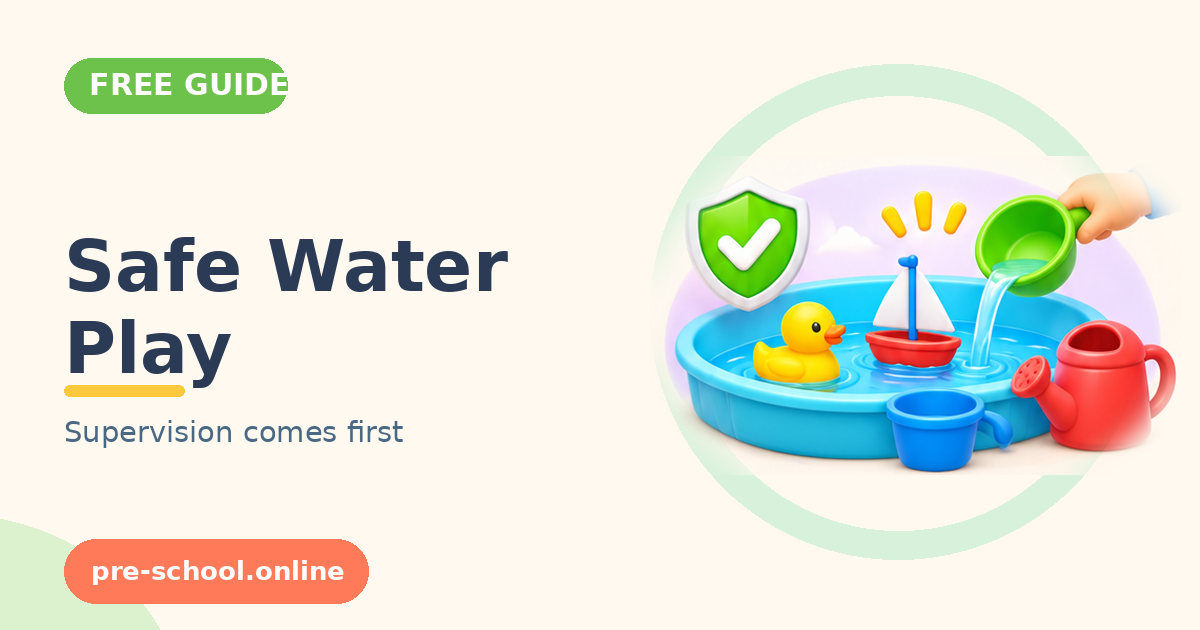
Pouring and scooping water can be delightful for preschoolers, but any activity involving open water requires a serious safety plan. The most important ingredient is an attentive adult close enough to intervene immediately—not a particular toy, water depth, or age label. Keep the play small, short, and simple, and empty every container as soon as the activity ends.
- Ages 3–5
- Practical parent & teacher ideas
- Free learning resources
Key Takeaways
- Have one attentive adult actively supervising within arm’s reach.
- Use only a little water in a stable, low container; depth does not remove drowning risk.
- Keep small objects, water beads and electrical devices out of the activity.
- Empty, dry and put away containers immediately after use.
In This Article
Understand the Learning Goal
Drowning can happen quickly and quietly. The American Academy of Pediatrics emphasizes close, constant, attentive, competent supervision around water. A shallow sensory tub or small bucket is not automatically safe. Children who are younger, unsteady, sensory-seeking or new to water may need even closer contact. An adult who is distracted by a phone, meal preparation or conversations cannot supervise adequately.
Choose a low, stable container away from electrical devices, plugs, heaters and tripping paths. Use a few large washable scoops, cups or toy boats that are too large to swallow. Do not use water beads, balloons, magnets or small loose parts. Decide who the dedicated water watcher is, stay within arm’s reach of young children, and never rely on an older child to take over supervision.
Eight Practical Activities and Strategies
Start with one manageable idea rather than attempting every activity in a single session. Model the steps, observe what your child enjoys and change the plan when circumstances or safety needs require it.
- Assign a dedicated water watcher first
Before the tub comes out, name the adult whose only task is watching the children. That adult stays close, attentive and able to intervene immediately. Put away phones and pause unrelated chores. If the adult must leave, even briefly, end the activity and remove the child from the water area. Do not transfer this responsibility casually to a sibling or another child. In group settings, follow childcare ratios and water-activity policies as well.
- Choose a stable, low play location
Put the tub on the ground or a low stable surface on a nonslip mat, where an adult can reach every side without obstacles. Keep it away from stairs, electrical outlets, charging cables and furniture that a child may pull on. Choose a container without sharp edges, cracked handles or a tip-prone base. Never leave water in a bucket at child height between activities, even if an adult intends to return soon.
- Use a small amount of water—not a false safety guarantee
Use the minimum water needed for the chosen scoop or float experiment, while recognizing that even shallow water demands uninterrupted supervision. Avoid large buckets, deep tubs and containers children could fall headfirst into. If a child repeatedly tries to climb in or put their face in the water, stop the activity and switch to a different kind of play. Never use water depth as the only protective measure.
- Provide large, simple tools
Offer two oversized cups, a large scoop, a sponge or an age-appropriate toy boat with no detachable small pieces. Check for broken edges or loose batteries and follow age labeling. Avoid water beads entirely; they are not an appropriate preschool sensory filler. Skip small decorative stones and tiny toy fish that might be swallowed, placed in ears or lost on the floor. Keep the tool set small enough to supervise easily.
Related free resource: Read Safer Sensory-Play Ideas includes ideas you can explore after this article. Use only the parts that fit your child and your setting.
- Model pouring and filling with clear words
Demonstrate filling one cup and pouring slowly into another while you remain next to the child. Use words like full, empty, more, less, float and sink. Let the child make a prediction, test it, and describe what happened in their own way. Do not demand precision or require children to hold slippery cups above their heads. Place a towel nearby so spills can be addressed immediately.
- Keep faces above water and play gentle
Set a rule that the activity is for hands and tools, not putting faces underwater or splashing at others. If children begin to splash forcefully, pause and reset or end play. Watch for slipping, cold discomfort and signs that a child is becoming overwhelmed. Water play is not a swim lesson or a way to practice breath holding. A child who does not want to touch the water can observe or use a dry sorting activity.
- Stop promptly when attention or conditions change
If the adult receives a phone call, another child needs immediate care, or the room becomes too crowded, close the activity rather than trying to supervise from a distance. Tell children what will happen: “We are finished with water. Let’s put the cups away.” Keep a dry towel and a safe storage place ready. A short, supervised water session is far better than a longer one with lapses of attention.
- Empty, dry and store every container
Pour water down an appropriate drain right after the activity, not into a bucket that remains accessible to children. Dry the floor, tools and tub, then store the container upside down or otherwise securely out of reach. Check under furniture and nearby shelves for small dropped items. Teach children to help hand over large tools but leave heavy lifting, draining and cleaning chemicals to adults. Never store standing water for “later.”
A Realistic Everyday Example
A parent sets a shallow tub on a nonslip mat, away from outlets, and places two large plastic cups next to it. She puts her phone away, sits within arm’s reach and watches as her four-year-old transfers water from one cup to another. They compare “full” and “empty” for seven minutes. When the doorbell rings, she ends the play, moves the child away from the tub and empties the container before answering. The activity worked because the supervision plan came first.
Notice what the child actually did rather than grading the session: asking for help, testing an idea, showing a feeling, recovering from difficulty or choosing a safe next step. One meaningful observation can guide the next practice opportunity.
A Flexible Five-Day Practice Plan
Use these short invitations in any order and repeat a favorite if it still feels useful. Five days is a menu, not homework or a developmental deadline.
| Day | Try this | Gentle follow-up |
|---|---|---|
| Monday | Check the area, container and adult-supervision plan. | What did you notice? |
| Tuesday | Try a brief two-cup transfer with uninterrupted close supervision. | What would make this easier? |
| Wednesday | Add one large sponge and compare how it holds water. | Can you show me your idea? |
| Thursday | Test one large safe object for floating or sinking. | What could we try differently? |
| Friday | Revisit a favorite experiment and practice immediate cleanup. | Which part would you choose again? |
Related resource: Explore a complementary preschool resource when you want another suitable activity or story.
Adjust for Different Learners
For children who are nervous about water or dislike wet hands, allow observation and use a dry tray with pretend cups. For children with limited mobility, set up an accessible height while keeping the water stable, the child supported and an adult close enough to intervene. Consult relevant support plans when a child has seizure, mobility or medical risks.
In classrooms, water play may be prohibited or require specific policies. Follow all program supervision, sanitation and accessibility rules. If there are too few adults to maintain continuous close attention for every participating child, use a dry alternative. Preschool ocean themes do not require actual water.
When Things Do Not Go as Planned
If any child appears distressed, has trouble breathing, is submerged, or is found unresponsive, activate emergency services immediately and follow emergency-response training; do not delay to finish cleanup. If a child is suddenly unaccounted for, check water locations first and initiate the program’s emergency procedures. If the floor becomes slippery, remove children from the play zone and dry it before anyone returns.
Low-pressure reminder: If the activity is uncomfortable or unsafe, pause or stop. There is always another way to explore the underlying idea; a child does not need to complete every suggested step.
Frequently Asked Questions
Is a shallow tub safe enough without constant supervision?
No. Shallow water does not eliminate drowning risk; an adult must remain close, attentive and able to intervene immediately.
Can preschoolers play with water beads?
No. CPSC warns about serious ingestion and insertion risks from water beads; choose other activities.
Can an older sibling watch the water station?
No. A responsible, competent adult should supervise young children directly.
What if I need to answer a call or leave the room?
End the activity, move the child away from water and empty the container before turning attention elsewhere.
Free Preschool Resources to Try Next
Continue with age-appropriate materials from Pre-School.online that directly relate to the learning goal. These resources complement the guidance here and do not replace adult support or safety supervision.
Read Safer Sensory-Play Ideas Explore Ocean and Water Curriculum
Sources and Further Reading
- Pre-School.online: Related Resource
- AAP: Drowning Prevention and Water Safety
- AAP: 2026 Drowning Prevention Policy
- CPSC: Water Beads Safety Center
This article provides general educational information for parents, teachers, and caregivers. It is not individualized medical advice. Follow applicable safety guidance, local school rules, and qualified professional advice for specific developmental or health concerns.