
Practical guide · Ages 3–5 · Early Learning Skills · PSB-0237
Remembering “put your cup down, then wash your hands” is different from reciting the alphabet by heart. Preschoolers use working memory to briefly hold information while acting on it, but that ability is still developing and depends on attention, language and the difficulty of the task. Playful sequencing games let adults support memory without asking children to prove that they can remember a long list under pressure.
Begin with a short two-part action that a child can see or copy, then increase the challenge only when they seem comfortable. A sequence of three pictures, a movement pattern or a pretend shop order can all be useful. Harvard’s Center on the Developing Child includes age-appropriate play for executive functions, including working memory, attention and self-regulation. Use the games below as enjoyable practice—not as a diagnostic test of intelligence or readiness.
- For families and preschool educators
- Play-based, practical guidance
- Adaptable for diverse learners
Key Takeaways
- Make the first sequence visible and achievable: two actions or two large picture cards are enough.
- Add one change at a time—length, delay, order or distraction—rather than increasing all demands together.
- Observe strategies such as looking back, using words or gestures and self-correcting; there is no universal score to meet.
Before You Begin
Choose three large picture cards, two soft toys, a short movement space and one tray. Use real photographs or simple drawings of familiar items. Begin in a low-distraction environment. Avoid tiny counters or objects small enough to choke a younger sibling. Provide a model once and let the child decide whether to lead or follow.
A useful approach: Model an activity once, invite a child to try it without pressure, then change one part of the task if it is too easy or too difficult. Children can watch, point, move or speak to participate.
Eight Practical Strategies and Activities
1. Copy two body moves
Demonstrate clap–tap-knees and invite the child to copy. Repeat slowly, then switch to stomp–reach or touch-head–clap. For a child who struggles, show one action at a time and then link them. Ask what came first only after the sequence is familiar. The aim is holding a brief action order in mind, not performing a speed test.
2. Use a hidden picture pair
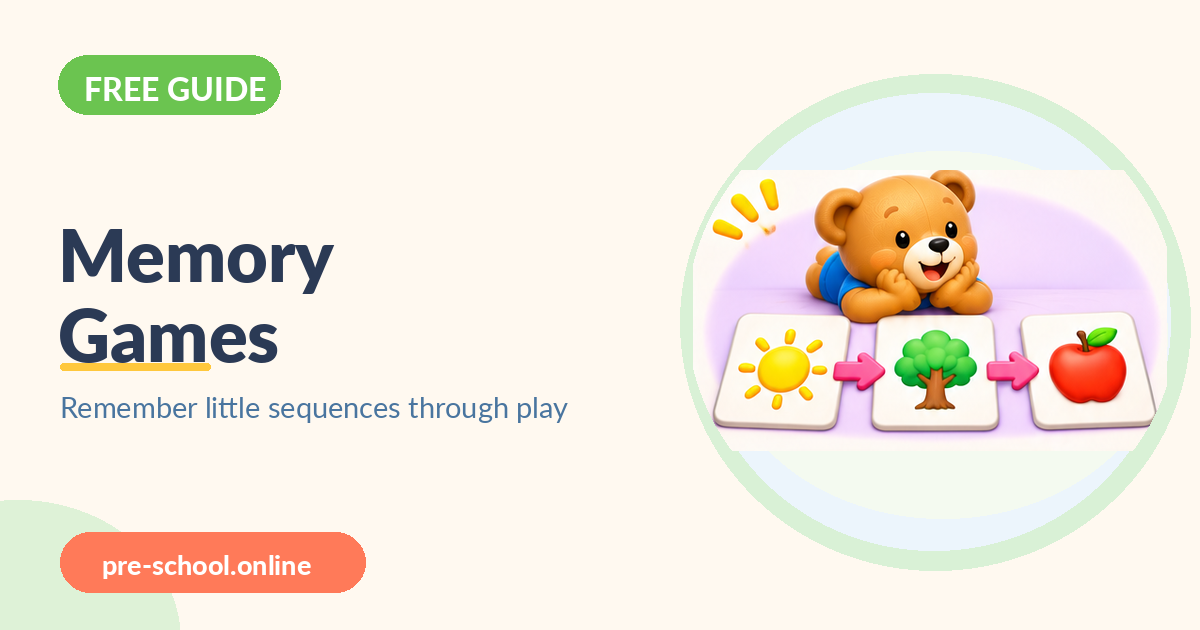
Show two pictures, such as sun and tree, for several seconds. Turn them face down and ask the child to recall or point to what they saw. Allow them to look again whenever needed. A beginner might simply match visible pairs first. Later use three pictures and ask “Which was in the middle?” Remembering and describing the order are related but different challenges.
3. Build a two-step toy delivery
Place a stuffed animal and a basket nearby. Say “Bring the bear, then put the ball in the basket,” using gestures. Let the child complete the steps with support; repeat with the same order before changing it. If a child walks off after the first instruction, reduce the distance or provide a picture cue. Realistic memory practice often looks like everyday play.
4. Make a pretend shop order
Set out three large pretend groceries. The adult asks for “one apple and one cup,” then waits while the child collects them. Ask what helped them remember; they might repeat the words aloud or point to a picture. Start with one item if needed. Do not introduce actual food, allergy risks or small loose materials into the play when unsuitable.
Related free activity: Explore Preschool Memory and Observation Games provides a relevant follow-up. The steps on this page can be used even without clicking away.
5. Build a color sequence
Arrange two big red blocks followed by one blue block, then hide the model and ask the child to recreate it. Use a visible model first so the goal is understanding the pattern, not memory under stress. Later ask “What came after blue?” Children may describe the colors in their home language; the ability to recall the order matters more than the language used.
6. Tell a three-picture story
Place large pictures of planting, watering and a flower in an order. Describe the sequence together, turn the pictures over and ask which one came last. If the child cannot recall, turn one picture back and tell the story again. Story structure gives memory a meaningful context: remembering events can be easier than memorizing disconnected symbols.
7. Try a gentle “what changed?” tray
Show three safe large objects on a tray for a moment. Hide the tray, swap one object, and reveal it. Ask “What is different?” without requiring the child to name everything from memory. If this is tricky, use just two objects or make the change obvious. The goal is noticing, comparing and remembering a small set, not catching a mistake.
8. Let the child become the leader
Invite the child to invent a two-action movement or a three-picture order for the adult to remember. The adult can model uncertainty: “I forgot the second part. Can you show me?” This demonstrates the use of prompts and respectful help. Some children gain confidence when the grown-up is allowed to make a mistake and try again.
At Home and in the Classroom
At home
Use brief practical sequences while setting a table or putting away toys: “Shoes on the shelf, coat on the hook.” Keep instructions short and pair them with simple visual reminders. Celebrate when a child asks for a repetition; requesting support is a useful skill.
In the classroom
Set out a visible sequence strip for arrival, washing or cleanup, and use games to practice it in calm moments. In a small group, invite children to make up movement patterns and switch leadership roles. Avoid public memory competitions where a few children repeatedly fail in front of peers.
For either setting, notice which parts of the activity the child chooses independently, where adult support helps, and whether the task still feels enjoyable. Keep the goal small enough to revisit without turning play into a performance test.
A Worked Example
Luca can copy clap–jump when watching the adult but forgets the order when the adult turns away. The teacher offers picture cards for hands and feet, practices clap–jump again and then covers one card. Luca repeats the action after looking at the remaining cue. The teacher does not label Luca as forgetful. Instead, they have found a support strategy—visual reminders—that may also help Luca manage a two-step classroom routine.
Why this example matters: The adult responds to what actually happens, adjusts support, and makes room for the child to participate. That kind of responsive teaching is more useful than insisting every child complete an identical set of instructions.
What to Notice and Record
Write down a brief observation rather than grading the child. It can be one sentence such as “Today, the child looked at the picture before choosing a response.” Compare it with later attempts and remember that children may show a skill differently in different environments.
| Look for | Possible observation |
|---|---|
| Sequence recall | Uses a gesture or cue to remember a step |
| Strategy | Repeats, points or asks to see the model again |
| Adult support | What prompt, change of materials or break made participation easier? |
| Child choice | Which action, question or approach did the child choose on their own? |
These notes are an informal planning aid, not a diagnostic screen. If a family has persistent concerns about daily functioning, communication, hearing, movement or development, a qualified professional can offer individualized guidance.
A Five-Day Practice Plan
Use these small invitations as a flexible starting point. On a busy day, two or three minutes of engaged play may be more valuable than finishing the whole activity. Repeat a favorite rather than moving on automatically.
| Day | Inviting activity |
|---|---|
| Monday | copy two gentle movements with a visible model. |
| Tuesday | remember a two-picture order with unlimited retries. |
| Wednesday | complete a two-step toy-delivery request using gestures. |
| Thursday | explore a three-picture story and what came last. |
| Friday | let the child lead a sequence for the adult to follow. |
At the end of the week, ask the child which experience they want to repeat and note one change you observed. The plan is not a requirement to master a skill in five days; it is simply a way to revisit useful play with varied examples.
Adaptations for Different Learners
- Use one action at a time and visible picture cues for children who need more support.
- Invite an experienced child to reverse a two-action order or extend it to three steps.
- Use movement, AAC symbols and home-language labels so speech demands do not obscure the memory task.
For preschoolers who have individualized education or therapy plans, follow their team’s recommendations and adapt the activity for access and comfort. Family language, culture, interests and communication style should shape the invitation—not be treated as barriers.
What Matters Most — and Common Misunderstandings
A child may remember a familiar story but not an unfamiliar instruction, or perform better in a calm room than in a noisy classroom. Working memory interacts with language, attention, sleep and emotional state. A single game result cannot establish a developmental delay. Focus on supportive strategies and meaningful play rather than increasing difficulty every session.
When Things Do Not Go to Plan
If a child repeatedly loses the second step, speak more slowly, pause, use gestures and simplify the environment. If a child becomes distressed by being asked to recall, put the cards back where they can see them and turn it into matching play. If difficulties are frequent across settings and affect everyday functioning, collaborate with caregivers, educators and an appropriate pediatric professional for individualized advice.
Frequently Asked Questions
How many steps should a preschooler remember?
There is no single number appropriate for every child and situation. Start with a familiar one- or two-step sequence and adjust based on language, context and support needs.
Do matching games improve memory?
They can provide chances to practice attention, remembering locations and noticing changes. They are enjoyable practice, not evidence of a specific improvement score.
What if my child asks for directions again?
Repeat them calmly or provide a picture cue. Asking for clarification is helpful and should not be treated as failure.
Should I use rewards for remembering?
Simple encouragement and meaningful play are usually sufficient. Avoid making memory tasks high-pressure contests or tying a child’s value to performance.
Try a Relevant Free Preschool Resource
Continue with the specific Pre-School.online guides below when they match your child’s interests and needs. The teaching ideas above are complete on their own, and the linked resources are optional practical extensions.
Explore Preschool Memory and Observation GamesBrowse More Preschool Games
Sources and Further Reading
- Harvard — Activities to Practice Executive Function Skills
- Harvard — Brain-Building Through Play
- Pre-School.online — Relevant Free Resource
Educational information for families and teachers; not an individual diagnosis or medical advice. Adults are responsible for supervision, product instructions, recalls, accessibility, local rules and seeking individualized professional help when needed.