
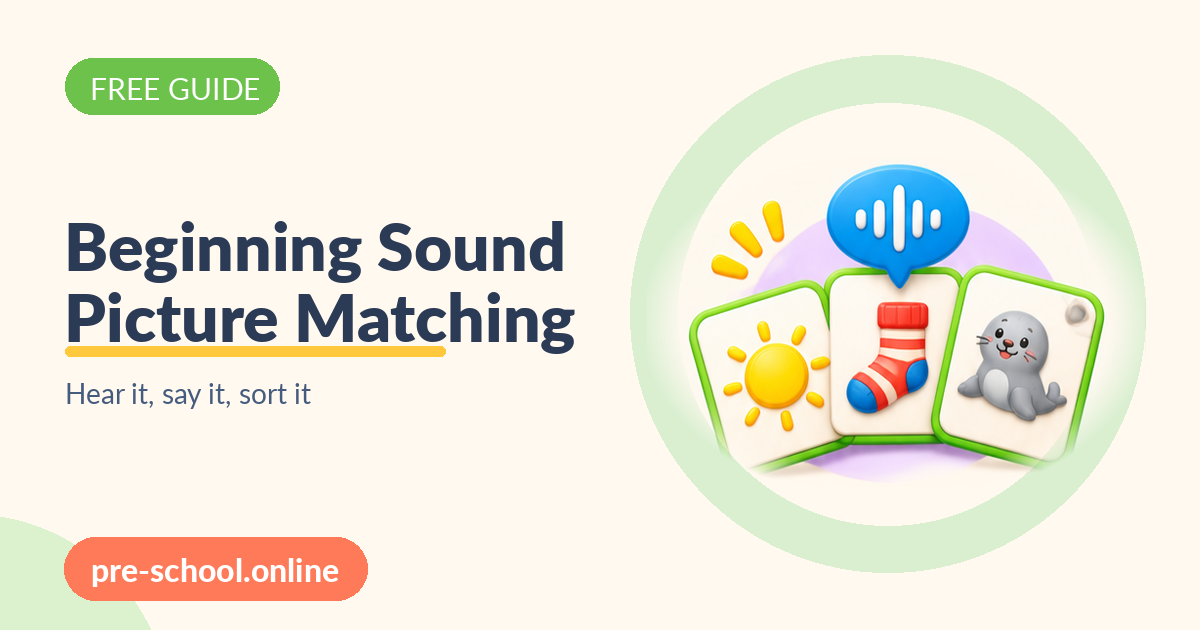
When a preschooler can name a picture but cannot tell which other picture starts the same way, the missing piece may be sound awareness—not letter knowledge. Before asking a child to match a written M to a moon, make the spoken /m/ in moon easy to hear. A child may know that a drawing shows a rabbit yet call it a bunny; that changes the expected beginning sound. Start by agreeing on each picture's name, model its first sound, and offer just two choices. The aim is enjoyable listening, not a timed phonics test.
- Ages 3–5
- Play-based
- Practical steps
Key Takeaways
- To teach beginning-sound picture matching, say the pictured word naturally, stretch a clear first consonant such as /m/ or /s/, and let the child choose between two familiar pictures. Model the answer, gradually offer three pictures, then invite sorting with the spoken words before adding printed letters. Keep practice brief and stop while it still feels like play.
- Pick one manageable activity and adapt it to your child’s interests, language, and current abilities.
Why This Approach Helps
Beginning-sound matching is a phonological-awareness activity: a child listens to spoken language rather than relying on printed symbols. It differs from naming a letter and from hearing a rhyme at the end of a word. Children may find /m/, /s/, and /f/ easier to notice when adults can gently prolong them. Avoid an exaggerated extra 'uh' after a consonant, which changes the sound. Reading Rockets describes picture and word sorting as useful ways to develop awareness of initial sounds.
The stages described below are invitations, not tests. You can model, shorten, repeat or adapt them for each child’s language, interests and support needs.
Seven Practical Activities or Steps
Begin with one step that fits your child and your setting. The suggested adult language is a model, not a script children must repeat word for word. Adjust the task before increasing pressure.
- Choose three unmistakable pictures
Use household photos, magazine pictures, or simple drawings of a moon, sun, and sock. Ask, 'What do you call this?' before starting: a picture you labeled 'sofa' might be called 'couch' by your child. Substitute a clearer picture instead of marking that answer wrong. Set the images where the child can point without needing to speak perfectly.
Try saying: “These are moon, sun, and sock. Let us say each name together.”Make it easier or harder: For a beginner, use only moon and sock; for an experienced listener, add mouse.
- Model one stretched beginning sound
Select a familiar word with a first consonant you can extend, such as sun. Say 'sun,' then 'ssssun' without adding a separate vowel. Have the child watch your lips or teeth if interested. A demonstration gives a useful pattern to imitate; it does not require the child to guess what is in the adult's head.
Try saying: “Sun begins with /s/. Listen: ssssun.”Make it easier or harder: If the child has speech-production differences, let them point or gesture; hearing and saying sounds are not the same skill.
- Offer a clear two-picture choice
Place sun beside moon and ask which begins like sock. Repeat the names once and give quiet thinking time. If the child points to moon, say the answer aloud and compare 'sock, sun' with 'sock, moon.' You do not need a correction lecture; one more modeled comparison often helps more than asking the same question repeatedly.
Try saying: “Sock starts /s/. Does sun or moon start with /s/ too?”Make it easier or harder: Use two pictures with strongly contrasting initial sounds before introducing close sounds.
- Make a sound-pair hunt
Once one match works, find a partner object in the room: spoon for sun, map for moon, fan for fish. Walk to each object and say the words slowly. Movement keeps the task concrete, and a physical pair on the table shows what 'same sound' means. Be prepared to change examples when local accents or the child's vocabulary affect pronunciation.
Try saying: “I found a spoon. Spoon and sun both begin /s/.”Make it easier or harder: For an easier version, the adult finds both objects. For a harder one, the child finds the second.
- Sort two families without printed letters
Create a 'sun' side and a 'moon' side with large pictures as headings. Offer four additional picture cards one at a time. The child can place a sock with sun and a mouse with moon. If the sorting breaks down, remove two cards and return to a shared demonstration. Printed S and M cards can wait until the child understands the sound-based sort.
Try saying: “Where does mouse belong if we are sorting what we hear first?”Make it easier or harder: Give immediate concrete feedback: say the pair aloud rather than only saying 'correct' or 'wrong'.
- Use a book without stopping every page
Read a favorite picture book for enjoyment. Choose one pictured object on a page and connect it to one other familiar word with the same initial sound. Then keep the story going. This avoids turning story time into a barrage of questions and helps the child notice sounds during authentic language.
Try saying: “Look, a bear! Bear begins /b/, just like ball. Back to the story!”Make it easier or harder: A child who is tired of the activity can listen while you model only one sound pair.
- Connect sounds to symbols only when ready
After repeated oral matches, show the corresponding letter on a large card: S for sun and sock. Say the sound, then the letter name, so the child hears that they are related but not identical. Do not insist that matching a printed card is required for a successful listening game. Return to playful speech sounds whenever letters become confusing.
Try saying: “We heard /s/ in sun and sock. This is one way we write that sound: S.”Make it easier or harder: Use the alphabet games or literature worksheets as a follow-up activity, not a test of all letters.
A Worked Example You Can Try
Try a six-minute 'sound detective' activity after a read-aloud. Minute 1: identify a picture of a sun and a picture of a moon. Minute 2: you say 'sun—ssssun' and 'sock—ssssock.' Minute 3: your child chooses which picture is the sound partner for sock. Minute 4: search together for a spoon, then place it beside the sun picture. Minute 5: add a mouse picture and say 'moon, mouse.' Minute 6: celebrate the two sound families and put the cards away. If the child does not match them independently, you still provided an accurate, friendly demonstration of the skill.
At Home and in Preschool
In a classroom, put three large picture cards on an easel and let small groups quietly compare sounds. A teacher can record which children need a model, two choices, or independent sorting; that is more useful than calling out wrong answers in front of peers. At home, use two familiar objects while cooking or tidying up. For children learning English alongside another language, name the picture before expecting an English sound match, and appreciate examples from the language they already speak.
Progress is visible when a child begins noticing the first sound without repeated prompts, even if they cannot yet name the letter. Revisit the same clear examples and try a new pair another day. If listening or speech concerns persist across settings, discuss them with the child’s educator and a qualified professional rather than relying on worksheets for diagnosis.
Adjustments for Ages Three to Five
Ages are approximate guideposts. Different children may need different supports, and progress does not need to follow a single timetable.
| Stage | Helpful adjustment |
|---|---|
| Around age 3 | A younger learner can enjoy naming pictures and copying one long beginning sound; correct sorting is not necessary. |
| Around age 4 | An interested four-year-old can match two pictured choices or place three familiar objects into two oral sound groups. |
| Around age 5 | An older or ready learner can sort four to six images and connect one familiar sound group to its printed letter. |
Common Pitfalls and What to Do Instead
When a child disengages or becomes frustrated, it is often better to change the task or offer support than to repeat the same demand.
| Avoid | Try instead |
|---|---|
| The child uses an unexpected word | Ask what they call the picture; teach the sound using that actual word or choose another image. |
| The example has an unclear beginning sound | Prefer familiar words with easy consonant starts rather than clusters, silent letters, or varied pronunciations. |
| Every answer becomes a quiz | Model several playful examples before asking; stop if the child loses interest. |
| The child can hear sounds but struggles to say them | Allow pointing and consult a qualified professional about persistent speech or hearing concerns rather than assuming disinterest. |
Frequently Asked Questions
Must my child know all the alphabet first?
No. Beginning-sound picture matching is primarily a listening activity. Letter names and printed symbols can be introduced as connected skills later.
Why does my child say “bunny” when the card says rabbit?
They may know a different, equally accurate word. Match the sound to the word the child uses or switch to a less ambiguous picture.
How long should we practice?
A few enjoyable minutes can be enough. Revisit the idea in books, walks, and play rather than running lengthy daily tests.
Free Preschool Resources to Try Next
Explore free literature worksheets and try one picture-to-sound match together. Choose what actually fits the child’s needs; you do not need to finish a collection in one sitting.
References and Further Reading
These resources support the educational approach and offer optional next steps. Only existing, relevant resources on Pre-School.online are linked above.
Sources
- Reading Rockets: Phonological Awareness Activities
- Reading Rockets: Preschool Language and Literacy Practices
This article shares general educational guidance for preschoolers. Follow current product instructions and official safety information where relevant; educational activities do not replace individualized developmental, medical, or professional advice.