
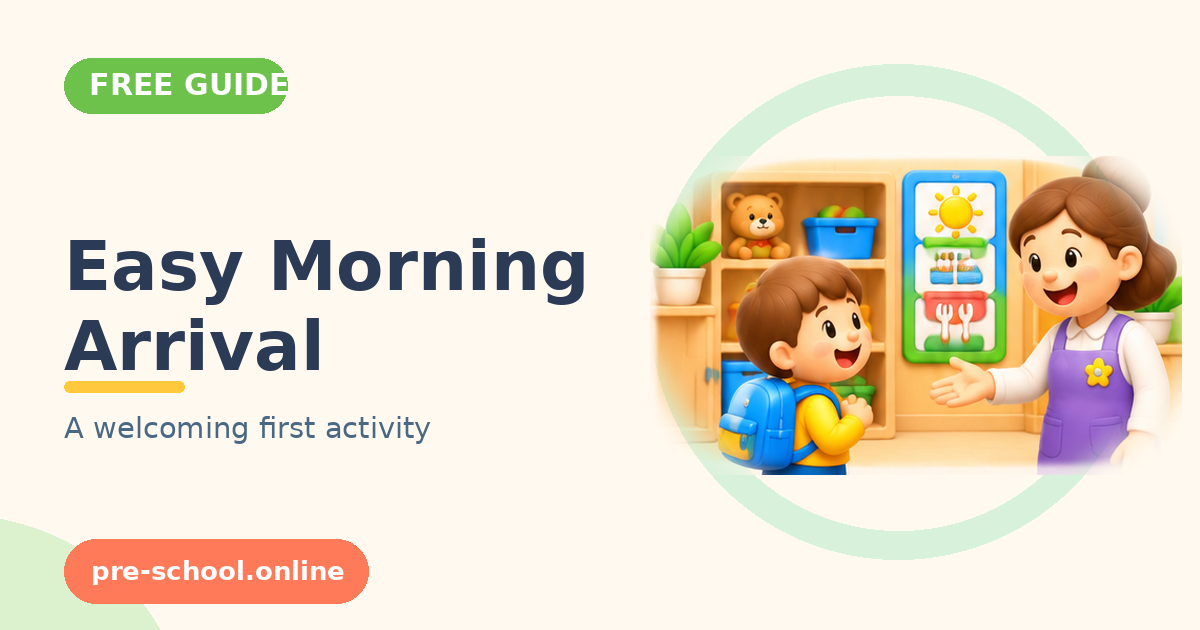
A welcoming preschool morning arrival activity can give children a clear place to begin while teachers greet families and settle the room. The key is choosing a predictable, low-pressure task that a child can join, leave and return to with minimal help. Think picture matching, large blocks or a familiar book basket—not a demanding worksheet before everyone has unpacked. Here is how to design an arrival station that supports belonging, transitions and independence without crowding the doorway or ignoring children who need extra time.
- Ages 3–5
- Practical parent & teacher ideas
- Free learning resources
Key Takeaways
- Set up one calm, familiar choice before children enter the room.
- Keep the activity short, visually clear and safe for children to manage with nearby supervision.
- Use a predictable greeting and visual arrival sequence, while allowing flexible pace.
- Observe which children need co-regulation or extra support rather than treating participation as a compliance score.
In This Article
Understand the Learning Goal
Morning arrival includes more than a separation from caregivers. Children must adjust to a different space, store belongings, notice peers and decide how to begin. A practical arrival activity reduces uncertainty by giving the child something familiar and reachable to do. It is not a substitute for individual connection: some children need a warm greeting or time beside a trusted adult before they can engage.
This post focuses on the activity after the goodbye, not the separation ritual itself. The best station has a clear start and finish, materials that cannot easily become hazards and enough flexibility for varied arrival times. Teachers can use a calm setup to observe early mood and engagement, but should not turn those observations into labels about a child’s ability or personality.
Eight Practical Activities and Strategies
Start with one manageable idea rather than attempting every activity in a single session. Model the steps, observe what your child enjoys and change the plan when circumstances or safety needs require it.
- Choose one clear purpose for the station
Decide whether the first activity should help children settle, connect or practice independent choices. A book basket may invite quiet connection; large blocks can offer a quick building challenge; a picture-match board can be completed in under five minutes. Avoid putting three new tasks on the table at once. A predictable activity needs little explanation and frees the adult to greet children rather than continually teaching the rules.
- Set the activity beyond the doorway
Place the station where entering children are not blocking the door, cubbies or exit routes. Use a low table or floor mat where materials are easy to reach, and give children a clear place to put finished work. Keep visibility open so staff can supervise arrival and play. Avoid loose cords, tiny pieces or high shelves. For mobility needs, ensure there is accessible space to approach and leave the station comfortably.
- Create a three-picture arrival cue
Make a simple sequence such as ‘hang bag, greet teacher, choose a game.’ Display it at child height with large pictures. The routine is a guide, not a reason to rush a tearful child. A teacher can point to the next picture rather than repeat an instruction across the room. If the child requires help with the cubby or bag, that is support, not failure. Maintain one familiar visual sequence for several days before changing it.
- Offer two low-mess starter choices
Children often like one small choice: ‘Would you like the animal book basket or the big shape puzzle?’ Put out two activities that the adult already knows are safe and manageable. Picture cards can represent the choices. If the child is not ready to choose, invite them to sit beside the adult and look first. Too many options increase decision load, especially at a busy arrival time. Rotate choices on a schedule rather than surprising children every morning.
Related free resource: Find Calm and Quiet Starter Games includes ideas you can explore after this article. Use only the parts that fit your child and your setting.
- Prepare an individual hello
Use the child’s preferred name and a brief greeting: ‘Good morning. I’m glad you’re here.’ Offer a wave, smile or hand gesture instead of requiring a hug or handshake. If the child seems distressed, acknowledge it quietly and follow the family’s agreed separation plan. A warm welcome is part of the activity, not something that can be replaced by a table full of supplies. Avoid public comments about who arrived late or who cried.
- Design a starter that can pause safely
Choose tasks that a child can stop if breakfast, toileting or class circle begins. A large-block structure, felt-shape board or short picture-book browse works better than wet paint or long crafts. Let the child place a ‘save my work’ card beside their blocks if they want to return. Avoid materials requiring constant adult manipulation at the busiest point of arrival. The first activity should help transitions, not create a second difficult transition immediately afterward.
- Include a quiet option for children who need it
Some children enter overwhelmed by noise or separation. Provide a small, supervised quiet spot with a familiar book or soft, age-appropriate object. Never isolate a child as a punishment or leave them unsupervised. A teacher can invite, ‘You can look at this book with me until you’re ready.’ This allows regulation before participation. Children who arrive full of energy may prefer a short, calm movement task with clear boundaries instead.
- Review the station using observations
After several mornings, note whether children enter smoothly, where clutter accumulates and which activities cause conflict. Ask a few children what they like and listen to family feedback. If the puzzle takes too long, reduce its pieces; if the book basket is ignored, choose books tied to current interests. Keep the basic arrival structure predictable even while changing individual materials. The test of success is a calmer, more inclusive entry, not identical behavior from every child.
A Realistic Everyday Example
A class of four-year-olds has a busy 8:30 a.m. arrival. The teacher places two oversized matching boards and a basket of sturdy animal picture books at the far end of the room. Each child hangs a bag, receives a personal hello and chooses a station. One child wants to sit quietly beside the teacher for two minutes before choosing a book. Another finishes matching immediately and begins a second board. The activity supports both children without requiring identical speed or forcing an immediate group performance.
Notice what the child actually did rather than grading the session: asking for help, testing an idea, showing a feeling, recovering from difficulty or choosing a safe next step. One meaningful observation can guide the next practice opportunity.
A Flexible Five-Day Practice Plan
Use these short invitations in any order and repeat a favorite if it still feels useful. Five days is a menu, not homework or a developmental deadline.
| Day | Try this | Gentle follow-up |
|---|---|---|
| Monday | Set up one familiar book or shape-matching station. | What did you notice? |
| Tuesday | Add a clear arrival picture strip and child-height supplies. | What would make this easier? |
| Wednesday | Offer two quiet choices without adding new rules. | Can you show me your idea? |
| Thursday | Watch where children need support or a pause. | What could we try differently? |
| Friday | Adjust materials and repeat the predictable greeting. | Which part would you choose again? |
Related resource: Explore a complementary preschool resource when you want another suitable activity or story.
Adjust for Different Learners
For children learning the classroom language, pair every spoken direction with a picture or demonstration. Children with sensory sensitivities may need a quieter corner or staggered entry. A child experiencing separation worries may need an agreed caregiver-teacher handoff plan; use the activity only after emotional support is in place.
For children eager for more challenge, add a simple open-ended task: ‘Can you build a bridge for the animals?’ without requiring everyone to do it. Older children may help reset large materials, but should never be responsible for supervising younger children or managing safety-critical parts of arrival.
When Things Do Not Go as Planned
If children rush to one station and argue, limit its capacity with visual spots and provide an equally appealing alternative. If a child cannot leave a task when circle time begins, announce the next step ahead of time and offer a ‘save and return’ option. If arrivals are consistently distressing, discuss with caregivers and educators rather than increasing activity demands. Remove any broken or choking-size pieces immediately. Never use a loud timer to pressure a child through a goodbye.
Low-pressure reminder: If the activity is uncomfortable or unsafe, pause or stop. There is always another way to explore the underlying idea; a child does not need to complete every suggested step.
Frequently Asked Questions
How long should a preschool arrival activity last?
Often five to ten minutes is enough, but allow flexibility for arrivals and individual transitions.
Should every child do the same arrival task?
No. A small set of predictable, low-pressure choices can support different interests and needs.
Can worksheets work as arrival activities?
They may for some children, but familiar books, large manipulatives and play options often create a gentler transition.
What if my child cries at arrival every morning?
Provide emotional support and coordinate with the teacher or caregiver. A station alone cannot solve persistent separation distress.
Free Preschool Resources to Try Next
Continue with age-appropriate materials from Pre-School.online that directly relate to the learning goal. These resources complement the guidance here and do not replace adult support or safety supervision.
Find Calm and Quiet Starter Games Browse Preschool Activity Ideas
Sources and Further Reading
- Pre-School.online: Related Resource
- NAEYC: Promoting Young Children’s Social and Emotional Health
- CDC: Milestones by 5 Years
This article provides general educational information for parents, teachers, and caregivers. It is not individualized medical advice. Follow applicable safety guidance, local school rules, and qualified professional advice for specific developmental or health concerns.