
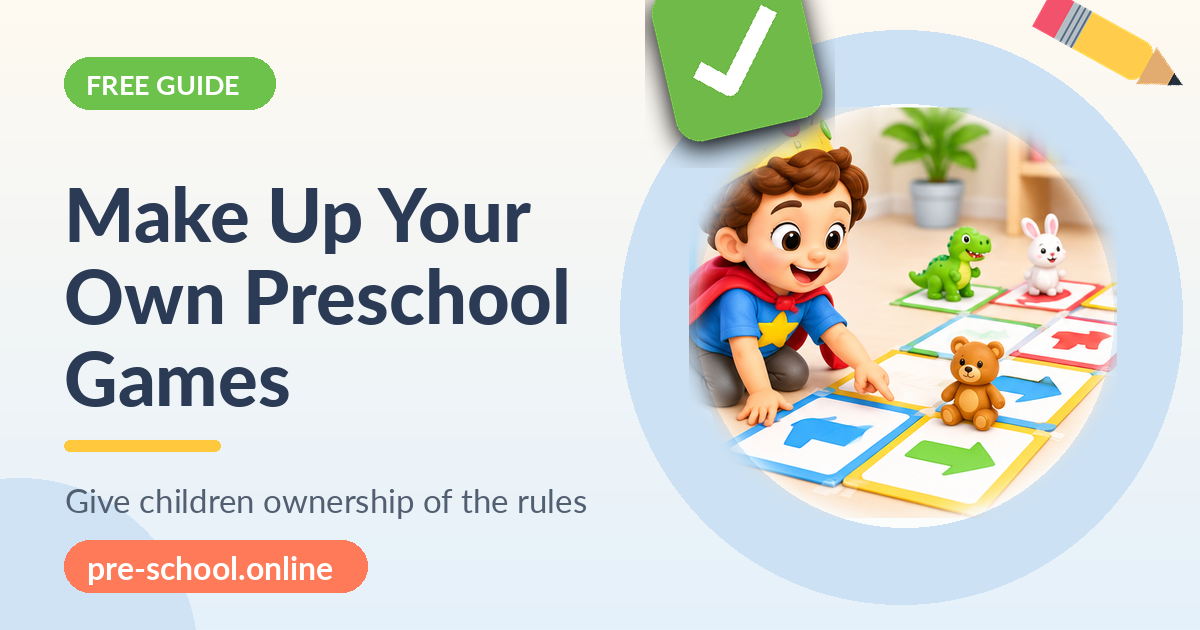
Free preschool guide · Ages 3–5 · Screen-Free Play
Quick answer: Invite a child to choose a pretend setting, a goal and one rule; play one short round, then ask what they would change.
- Research-informed context
- Real-life teaching examples
- Age-flexible activities
What matters most
- Offer open-ended materials and a question rather than a complete game.
- Test one simple rule before adding complexity.
- Let the child revise the game while protecting safety and fairness.
How children learn to invent games
A child inventing a game is doing more than “making up rules.” They are testing an idea, explaining it to someone else, noticing when it does not work and changing it. This is valuable even when a game lasts three minutes. Adults can support the process with a small collection of open-ended materials and a few questions, without becoming the designer of every game.
Begin with a simple invitation: “We have four cushions and three stuffed animals. What could we play?” If the answer is silence, offer a choice of settings—animal hospital or rescue mission—rather than a complete game. Let the child pick a goal, create one rule and demonstrate a first turn.
The six-part game-maker method
- Choose the story: What are we pretending? A jungle, a shop, a spaceship or something new?
- Choose a goal: Find the animal, deliver a letter, build a path, or make a silly sound.
- Choose safe materials: Large blocks, cushions, paper, scarves or picture cards; check the room and the youngest player.
- Make one rule: “The toy fox can jump only on blue spots.” Start small.
- Test one round: Play briefly. The child may discover a rule is impossible or confusing.
- Revise and rename: “Should we move the blue spot? What shall we call our game?”
Write the rule with a picture if the child wants to remember it. Not every invented game needs winners, points or an endpoint. Cooperative and pretend games can have goals such as rescuing every animal or telling a funny story together.
Ten easy starting points for child-designed games
1. The animal rescue route
Set out three large stuffed toys and two floor spots. Invite the child to invent how to reach each animal: tiptoe, crawl around a cushion or carry a rescue basket. Keep the path clear and low. Ask them to explain one rule to you. If the route is too hard, say “How could we make it possible for everyone?” rather than correcting it yourself.
2. Make a color delivery service
Use large paper “parcels” in two colors and matching paper houses. A child chooses how deliveries are made: walking, pushing a toy cart or sorting while seated. They may invent a special delivery sound. Add a new address only when the rule is familiar. This can include a child with limited mobility through tabletop delivery.
3. Invent a silly freeze game
Put on music at a comfortable volume and ask the child to choose two movements. They decide what happens when the sound stops: freeze like a statue or become a sleepy cat. If freeze is frustrating, allow “slow motion” instead. Keep physical boundaries and stop when bodies are tired.
4. Design a three-card quest
Draw three large icons, such as a tree, a star and a house. The child decides what each means: tell a joke, do a dance, or name an animal. Move a toy through the cards. If the child changes the meanings mid-game, ask whether you should start a new round with the new rule.
5. Create a pretend restaurant challenge
Use safe, large dishes and paper food pictures. Ask the child to create a special menu and decide what an “order” means. A game might be to serve a three-color plate or trade a pretend meal for a song. Keep fantasy separate from real dietary or allergy decisions.
6. Build a cooperative tower test
Offer oversized blocks and let the child invent an experiment: How many levels can a tower have before it wobbles? They may make rules about using one hand, alternating colors or rebuilding after a fall. Avoid tall, heavy stacks and keep younger siblings out of the block landing area.
7. Make a rhyme treasure hunt
Hide large picture cards on a table or in plain sight. Invent clues such as “Find something that rhymes with cat.” A child who isn’t ready for rhyme can match first sounds or categories instead. They can create the next clue and decide what treasure means—it might be a round of applause.
8. Design your own board game
Draw a short path of five or six large spaces. A child chooses two symbols and a simple action for each, such as “Wave” or “Tell a story.” Move a large token by drawing number cards from one to three. Skip dice or tiny counters for children who mouth objects, and do not force counting beyond a child’s comfort.
9. Turn a cardboard box into a mission
A medium open box can become a post office, vehicle or puppet theater. Ask the child to decide the purpose and invite you to play a role. Adults should inspect sharp staples, tape and any cords, keep openings large, and never encourage a child to close themselves inside a box.
10. Create a kindness mission
The child chooses a helpful quest, such as delivering a drawing to a family member or finding three ways to include a toy character. Discuss how real people are free to accept or decline invitations. This turns a game into perspective-taking without making kindness a competition.
How an adult can guide without taking over
Use prompts that transfer decisions back: “Show me the first turn”; “What will happen if we move this?”; “Does the rule still work?”; “What could a smaller child do?”; “Do you want to keep or change that?” Avoid declaring an invented game wrong because it is unfamiliar. Step in when a rule becomes unsafe, excludes someone unfairly or makes the game upsetting.
Children often change rules because their idea is developing, not because they intend to cheat. During solo play, rule changes can be part of imagination. During group play, explain the social difference: “You can invent a new version, but tell everyone before the next round.”
Adapt game invention for preschool abilities
| If the child needs… | Try… | Preserve the child’s choice by… |
|---|---|---|
| More language support | Two picture options and adult modeling | Letting them choose the goal or action |
| More movement | Floor spots and quick rounds | Asking what movement belongs to each spot |
| Lower sensory demand | A quiet tabletop version | Letting them choose the characters or rules |
| Greater challenge | A second rule or an unexpected event | Inviting the child to revise rather than answer an adult quiz |
When invented games go wrong
If the game is repetitive, remember repetition is practice and enjoyment. If the child wants you to lose every time, try a cooperative objective and explain fairness gently. If rules change too quickly, introduce a visible “new round” card. If a sibling refuses to join, respect their answer and find a different partner or play solo. If frustration grows, simplify the goal, make a quick success possible and end warmly.
Try a family “game-maker Friday”: save one new idea each week on a card with a name, a drawing and one rule. This creates a genuine record of the child’s creativity instead of a scorecard. Explore more preschool learning games and open-ended preschool toys.
Explore more free preschool learning resources
Choose a next step that fits your child’s interests, abilities and everyday routine.
Frequently asked questions
Is it okay if my child keeps changing the rules?
Yes, especially in solo pretend play. In group play, encourage the child to announce changes between rounds so everyone understands.
Does a made-up game need winners?
No. A shared mission, story or building challenge can be satisfying without points or competition.
What if my child says they have no ideas?
Give two playful choices, such as rescue mission or pretend shop, and let them decide the first action.
Can children with limited speech invent games?
Absolutely. They can choose characters, movement, colors and actions through pointing, pictures, gestures or AAC.
Sources and further reading
These references offer further context or official safety information; they do not replace guidance tailored to your child.
- Pre-School.online: Preschool Games
- Harvard Center on the Developing Child: Executive Function Activities
These suggestions are for general educational use. Choose activities for the individual child and setting, follow product instructions and local safety guidance, and seek qualified professional help for specific developmental, medical or safety concerns.