
Practical guide · Ages 3–5 · Feelings and Behavior · PSB-0232
When two preschoolers want the same toy, an adult may ask them to “use your words.” But those words are hard to find when feelings are strong. Puppets let children rehearse simple phrases before the real problem happens. A sock puppet can want a turn, feel left out, make a mistake or change its mind without anyone being labeled the difficult child. This guide shows how to build a language toolkit for everyday conflicts through short, safe pretend-play scenes.
The goal is not to make children deliver a flawless script or force them to share every possession. It is to model a few useful options—naming a problem, stating a boundary, asking for help and offering a next step—while adults continue to protect physical safety and support regulation. Try one tiny scene at a time with a puppet, a soft toy and an object that can be safely shared.
- For families and preschool educators
- Play-based, practical guidance
- Adaptable for diverse learners
Key Takeaways
- Teach a small set of usable phrases such as “Stop, I need space,” “Can I have a turn after you?” and “Please help.”
- Rehearse with puppets when everyone is calm, then coach gently during actual disputes.
- Offer fair choices and boundaries; a child is not required to share a special object or accept unwanted touch.
Before You Begin
Bring two hand puppets, sock puppets or stuffed animals, plus a toy car or block tower. Choose a five-minute slot when children feel settled. Make sure strings, buttons and detachable puppet pieces are secure and appropriate for the age group. Start with only two characters and one uncomplicated problem. An adult narrates first; the child may answer, point or move a puppet rather than speak.
A useful approach: Model an activity once, invite a child to try it without pressure, then change one part of the task if it is too easy or too difficult. Children can watch, point, move or speak to participate.
Eight Practical Strategies and Activities
1. Give each puppet a clear feeling
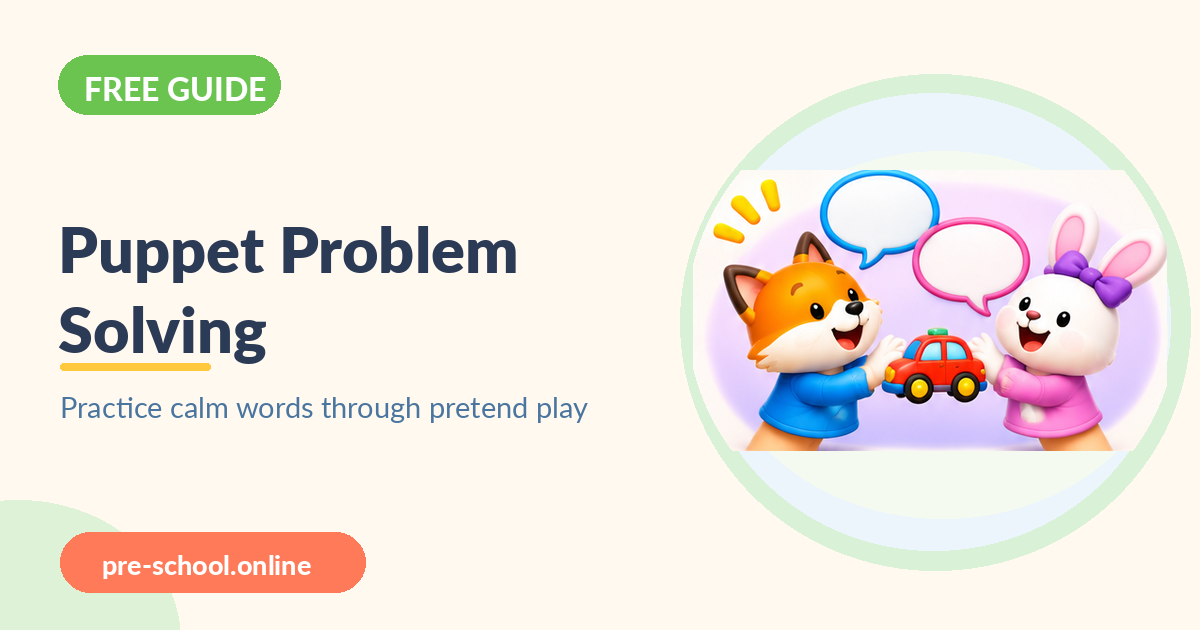
Show Puppet Fox holding a car and Puppet Bunny waiting. Say “Bunny wants a turn; Bunny feels disappointed.” Pause for a face or gesture. Children often need emotional vocabulary before solutions make sense. You can make a simple face for waiting, excitement or frustration. Avoid asking “Who is bad?”; both characters can have legitimate needs.
2. Model one boundary phrase
Have Bunny reach for Fox’s car; Fox says, “Stop. I am playing with it.” Then Bunny moves back. Explain that a child can politely protect a boundary and ask an adult for help if someone does not listen. Role-play gentle hands and a respectful distance. It matters that adults model stopping immediately when a child says no to unwanted touch.
3. Offer a realistic request for a turn
Try the phrase, “Can I have it when you are finished?” Let Fox answer yes, later, or no if it is a personal object. Show how Bunny can choose another toy or request adult support. If timing is unclear, an adult might propose a short agreed turn system for shared classroom materials. A timer helps only if all players understand the plan and are not already overwhelmed.
4. Practice describing the problem
Make the puppets collide while building: “The tower fell when we both reached.” Invite the child to complete “The problem is…” with words, pictures or a gesture. Adult language can be even shorter: “Two hands, one block.” Recognizing what happened is different from deciding whom to blame. Children who cannot yet describe events may do better if adults narrate objectively.
Related free activity: Explore Pretend-Play and Life-Skills Activities provides a relevant follow-up. The steps on this page can be used even without clicking away.
5. Teach a small menu of solutions
Place three picture options beside the puppets: take turns, play together, ask for help. Show the same dilemma three times with different endings. Ask “Which could work today?” rather than demanding the child pick the adult’s favorite answer. If a proposed solution is unsafe or unfair, calmly model why it needs changing. Problem solving includes saying that an idea does not work.
6. Rehearse repair without forced apologies
Let Puppet Fox accidentally knock over Bunny’s tower. Have Fox say “I knocked it down. Can I help rebuild?” A repair may include checking whether the other child is okay, fixing a problem or allowing space. A memorized “sorry” is not a substitute for understanding. Adults can model sincere words without insisting on hugs, eye contact or immediate forgiveness.
7. Move from puppets to a real play task
After rehearsal, bring out two large blocks and invite both children to build. Coach only as needed: “You both want the red one. What could help?” Refer to the puppet scene if useful. If children begin hitting or grabbing, intervene, keep everyone safe and return to practice later. A real dispute is not the best moment for a lengthy lesson.
8. Let children invent the next scene
Ask a child to create a dilemma: a puppet gets left out of a game, does not like loud noises or wants to keep a drawing. The adult plays the puppet who listens and helps. Children may choose silly voices or repeat the same scene; repetition builds familiarity. Follow their imaginative lead while keeping the language simple and respectful.
At Home and in the Classroom
At home
Use sock puppets for one recurring challenge, such as choosing a book at bedtime or taking turns with a favorite car. A parent can model both sides without turning the scene into a lecture. Talk briefly afterward: “Which words might help if that happens to you?”
In the classroom
Create a small puppet basket next to the social-emotional area. One adult models a 90-second scene for a few children, then invites them to act out variations. During real conflicts, use the same neutral phrases and help children carry out the solution they selected.
For either setting, notice which parts of the activity the child chooses independently, where adult support helps, and whether the task still feels enjoyable. Keep the goal small enough to revisit without turning play into a performance test.
A Worked Example
During block play, Maya says “Mine!” as Eli reaches for a blue block. Later, an adult uses two puppets and one blue foam block. Puppet One says, “I am using it”; Puppet Two says, “Can I use it when you finish?” Together they practice choosing a second block while waiting. The next day the adult reminds Maya and Eli of the phrases during a calm moment. Nobody must repeat them verbatim, but the shared script gives them a starting point.
Why this example matters: The adult responds to what actually happens, adjusts support, and makes room for the child to participate. That kind of responsive teaching is more useful than insisting every child complete an identical set of instructions.
What to Notice and Record
Write down a brief observation rather than grading the child. It can be one sentence such as “Today, the child looked at the picture before choosing a response.” Compare it with later attempts and remember that children may show a skill differently in different environments.
| Look for | Possible observation |
|---|---|
| Problem language | Names or gestures a need while calm |
| Repair attempt | Chooses an option or requests adult help |
| Adult support | What prompt, change of materials or break made participation easier? |
| Child choice | Which action, question or approach did the child choose on their own? |
These notes are an informal planning aid, not a diagnostic screen. If a family has persistent concerns about daily functioning, communication, hearing, movement or development, a qualified professional can offer individualized guidance.
A Five-Day Practice Plan
Use these small invitations as a flexible starting point. On a busy day, two or three minutes of engaged play may be more valuable than finishing the whole activity. Repeat a favorite rather than moving on automatically.
| Day | Inviting activity |
|---|---|
| Monday | puppet names a feeling and an object wanted. |
| Tuesday | puppet practices “Stop, I need space.” |
| Wednesday | two puppets request turns and choose waiting alternatives. |
| Thursday | puppets make a mistake and offer a useful repair. |
| Friday | child invents a problem and chooses among three solutions. |
At the end of the week, ask the child which experience they want to repeat and note one change you observed. The plan is not a requirement to master a skill in five days; it is simply a way to revisit useful play with varied examples.
Adaptations for Different Learners
- For emerging speakers, offer picture cards for stop, help, turn and together; pointing counts as communication.
- For children who feel stressed by role-play, begin by watching an adult operate both puppets.
- For confident storytellers, introduce competing needs and ask for two fair solutions, not one “correct” response.
For preschoolers who have individualized education or therapy plans, follow their team’s recommendations and adapt the activity for access and comfort. Family language, culture, interests and communication style should shape the invitation—not be treated as barriers.
What Matters Most — and Common Misunderstandings
A phrase rehearsed in a calm moment may not be available when a child is distressed. Adults must co-regulate, help protect boundaries and support repairs rather than expecting independent conflict resolution at age three. Sharing and taking turns are social skills, but they should not be taught as a rule that children must surrender any object immediately when asked.
When Things Do Not Go to Plan
If a child makes the puppets fight, gently turn the scene into a problem the characters can solve, without moralizing. If they refuse to speak, invite them to move the puppet or choose a picture card. If conflicts frequently involve injury, persistent fear or major disruption, work with the child’s family and educator to identify triggers and agree on supportive strategies. A general blog cannot replace individualized behavior support.
Frequently Asked Questions
Should I force my child to say “sorry”?
Model a meaningful repair and give time for the child to calm down. Forced words without understanding are less useful than checking on the other child and practicing a safer next step.
What if my preschooler does not speak much?
Use pictures, gestures, one-word choices or adult narration. Communication can be supported without demanding a long spoken sentence.
Can puppets help with hitting?
They can rehearse safe alternatives in calm moments. During hitting, adults need to stop the behavior, ensure safety and respond to underlying needs; puppet play is not a substitute for immediate supervision.
Is taking turns always the answer?
No. Other options include making a shared plan, finding another material, asking an adult, or respecting that some possessions are private.
Try a Relevant Free Preschool Resource
Continue with the specific Pre-School.online guides below when they match your child’s interests and needs. The teaching ideas above are complete on their own, and the linked resources are optional practical extensions.
Explore Pretend-Play and Life-Skills ActivitiesBrowse More Preschool Activities
Sources and Further Reading
- NAEYC — Promoting Young Children’s Social and Emotional Health
- Harvard — Brain-Building Through Play
- Pre-School.online — Relevant Free Resource
Educational information for families and teachers; not an individual diagnosis or medical advice. Adults are responsible for supervision, product instructions, recalls, accessibility, local rules and seeking individualized professional help when needed.